Pages

Monday, April 13, 2015

Der Schlangkeenich - The Snake King

Features:

The general word for "snake" in Deitsch is "die Schlang," thus, a snake is grammatically feminine.

One reference to the "Schlangekeenich" is translated as "snake queen" rather than "snake king," perhaps due to the use of the term "Keenich" rather than "Keenichen" (or "Keenichin") for "queen bee" in most variants of Deitsch. This reference appears in Richard Wentz's "Pennsylvania Dutch Folk Spirituality" (p. 199). Despite the gender difference between Wentz's reference and the clear reference to a King in this version, other features are identical. For example, the "snake queen's" whistle will rally all snakes "to waylay and fight the wayfarer." This whistle is reflected in the folk tale.

Additionally, there is also a tale called "The Snake King" in the diaspora in Ontario in W. J. Wintemberg's "German Folk Tales Collected in Canada" (Journal of American Folk-Lore, p. 243, 1906).

Phares Hertzog has a article titled "Snakelore in Pennsylvania German Folk Medicine" in "Pennsylvania Folklife" vol. 17 no. 2 (Winter 1967) pp. 24-26. I have this issue and will dig it out. I do not remember his viewpoints on it.

In addition to dragon-types of creatures like the Snallygaster, here are two cryptozoological snakes in oral lore (Wentz refers to them on p. 199): the Reefschlang (Hoop Snake) and the Hannschlang (Horn Snake). The hoop snake appears in wider American lore.

As is the case with much of the rest of "Teutondom," dragons and serpents guard treasure (see also Henry S. Gehman's "Ghost Stories and Old Superstitions of Lancaster County" in "Pennsylvania Folklife," vol. 19, no. 4 (Summer 1970), pp. 48-53). In the case of the Schlangkeenich, the variants seem to reflect local lore regarding real or legendary resources. Gold appears in one variant. Silver, diamonds, and gems (particularly garnet) appear more frequently.

Braucherei is almost inconsistent when it comes to snakes. Despite many references to "thou, snake, alone are cursed," there are many incantations that call to snake spirits for the removal of poisons, charming, even fertility. As reflected in the story, snakes are simultaneously independent yet fiercely loyal to their King and their den. Another common perspective is that a snake is a snake: not inherently evil or cursed, but it must eat and defend itself as a snake must.

There are several additional folk tales that relate to snakes guarding treasure, though these do not refer to Snake King. They carry some similar themes, though.

DER SCHLANGKEENICH

(Variant B Harmonized - all nine informants were from the area of Palm and Zieglerville, PA - seven of the nine were of Schwenkfelder descent).

Harr and Fraa Keller (name randomly chosen) owned a farm in Franconia (PA). Unfortunately, having been caught placing damaged apples at the bottom of market baskets while placing shiny ones on the top, they had developed a reputation for being untrustworthy and greedy.

One day, Fraa Keller was collecting apples in her field when she spied a small horn-tailed snake (Hannschlang) slithering alongside a rock. Fraa Keller saw what she thought was a mouse in the snake's mouth, so she drew closer to get a better look. As she approached the snake, she could see it was not a mouse but a large garnet crystal in the snake's mouth.

Fraa Keller asked the snake where the garnet came from, and the snake replied that she had been given the garnet as a reward for good service to the Snake King. Fraa Keller grew excited by the idea that the Snake King might have more gems, so she asked where she might seek an audience with the Snake King. The snake responded that she was not permitted to share the location of the den.

Fraa Keller replied that she understood, but she was not about to give up the quest. She asked whether the snake would be willing to trade the garnet for something else. The snake replied that she was thirsty and would welcome a drink, and the hospitality would be rewarded with the garnet.

Fraa Keller ran into her kitchen where she concocted a drink to charm the snake into telling the truth, placing it into a bowl for the snake to drink.1 She then returned to the thirsty snake. The snake dropped the garnet and heartily drank the concoction.

Shortly after finishing, the snake began to feel dizzy, and her vision became blurry. She began to slither back toward the rock, but Fraa Keller stood before her and uttered an incantation.2 The snake panicked but felt a loss of control.

Fraa Keller, having charmed the snake, again asked her where the Snake King could be found. Against her own will, the snake replied with the location. She also added a warning, "Anyone who enters the den and tries to harm the King or to steal his hoard will be buried alive."3

Satisfied with the answer, Fraa Keller released the charm, but the potion had poisoned the snake, and she died.

Fraa Keller took the garnet and ran to her husband. She informed him of the Snake King's hoard, which excited the greed within him, too. Fraa Keller urged Harr Keller to go after the hoard, but, remembering the snake's warning, she advised him to take along a large bag, a beam of wood and a shovel. "After all," thought she, "we would not want the treasure to get buried without tools to release it."

The Kellers went to the location and found a hole wide enough to step into. Fraa Keller did not give it a moment of thought to wonder why the hole was so large when the snake she killed was so tiny. As Harr Keller stepped into the hole, Fraa Keller said, "I will wait for you here to help you out."

Harr Keller stepped into the entrance of the hole. He took one more step and fell into a large pit that was lit only from the sunlight coming in from the hole. However, the sunlight was reflected by garnet crystals that adorned the walls and covered the floor in piles.

Harr Keller began to shovel the garnet from the piles into the bag, but then he heard a loud hiss. A large horn-tailed snake seemed to appear from the wall. Upon his head he wore a gold crown adorned in large, polished garnet.

"You must be the Snake King," Harr Keller said.

The Snake King looked fixedly at Harr Keller and replied, "Yes, and who are you who is stealing my treasure?"

Harr Keller replied with a lie, "Does a snake need treasure? One of your own traded this treasure to my wife for a drink. She has part of the payment in her possession."

The Snake King, being much shrewder than Harr Keller had expected, responded, "Whether a snake needs treasure or not, it is not yours to take, and your claim is a lie."

Harr Keller, recognizing that he was in trouble, took the shovel and attempted to strike the Snake King on the head. However, he hit only the crown, and the garnet deflected the strike. Harr Keller dropped the shovel, and the Snake King slid upon it.

The Snake King let out a powerful hiss that turned into a whistling sound, and all the snakes in his realm heard his call and headed toward the hole. Fraa Keller, hearing the rustling in the grass, sensed danger. She clutched her garnet and abandoned her post, returning to her kitchen.

Meanwhile, Harr Keller tried to hide from the Snake King among the garnet piles. Using his mighty horned tail, the Snake King smashed the piles, causing the crystals to fly through the air, pelting Harr Keller in the face.

The commotion caused the roof of the pit to weaken, and dirt began to fall upon Harr Keller's head. Hiding behind a pile of treasure, he reached for the beam of wood, hoping that it would brace the ceiling.

The Snake King approached the beam, and Harr Keller called out, "If the pit caves in, you will be buried, too."

The Snake King responded, "Does a snake need a pit? My kin and I can dig our own way underground." He then used his tail to smash the beam. The ceiling caved in, burying Harr Keller.

The Snake King dug his way to the surface, where his army of loyal kin awaited him. He told them of Fraa Keller's treachery. He ordered them to seek out the woman with garnet. His army made its way toward the Keller's house, passing in horror the body of their deceased sister.

The Snake King slammed through the kitchen door with his horned tail, which allowed his army to enter. Fraa Keller attempted to utter the incantations against the Snake King, but, before the words could leave her lips, the army set upon her, biting, stinging, and twisting around her.

The Snake King found the traded garnet and, taking it in his mouth, returned to the spot where the first snake had been poisoned. He used the garnet to scratch into the soil, beginning a new den where he and his kin could live in peace.

-----------------------------
1 There are a few of these hypnotic "truth serum" types of concoctions reported, and they would fall under Verbot because of the removal of another's free will normally violates many tenets of Braucherei. I can say a few of the known ingredients often include hemp dogbane, violets and passionflower, but some of the other reported ingredients are potentially toxic to humans.

2 There are quite a few charms for snakes. An example:

Schlangel, Schlangel
Beiss mich net
Hald dei Saft
Bischt du yetz
Unn'r meinre Graft
Schlangel, Schlangel
Saag die Waahret
Zu meinre Frooget

Little Snake, Little Snake
Bite me not
Hold thy juice (venom)
Thou art now
Under my power
Little Snake, Little Snake
Say the truth
to my question

3 Caving in of ceilings, walls, or vaults is not an uncommon theme in Deitsch folk tales that relate to theft.

------------------
Informants (year 2010):

1, 2, 3, 5, 6, 7, 9 Schwenkfelders requesting no identity
4. K. Freed, Montgomery County
8. E. Renninger, Montgomery County

Tuesday, March 10, 2015

Oschdre (Where Color Comes From; Origin of the Distelfink)

-------------- PREFACE --------------

Rob had only heard parts of this when he was younger, mostly from relatives or friends of relatives from the stretch between Ashfield and Bowmanstown (version A), PA but also from the Berwick area (version B).  In 2012, Rob asked around the two areas and got leads on some people who may know about the story, and he ended up with 10 new informants for a total of 17. Other informants were familiar with one or two points of the story but not enough to make a significant contribution. More than half of the informants came from farther south, in a stretch from Orwigsburg to New Ringgold (version C). Their versions of the story bore more information and some distinct contrasts with those of the two northern areas. Thus, this particular myth has undergone some reconstruction using as a base the information that the informants provided. The more important variations are noted with footnotes below.

It should also be mentioned that only four informants (all of whom self-identified as knowing Braucherei or Hexerei), looked at any aspect of this as being anything beyond a metaphor. Informant #11 specifically referred to the three Ladies as "goddesses"; #8 referred to Oschdra as a "helpful entity";  #13 and #15 referred to the sisters as "helpful spirits." Therefore, it cannot be said that this was a widespread myth with religious significance historically, but it is applicable to the modern perspectives of Urglaawe.

It is also by no means certain that this is of any particular antiquity; it may be a story that arose in the foothills since the settlement. Thus, it is prudent to encourage readers to look at this as a new myth or a reconstruction or a retelling of a regional folk tale while allowing individuals or kindreds to view it as they will.

Michelle A. Jones and Robert L. Schreiwer

-------------- DIE OSCHDRE --------------

Three sisters, Helling, Nacht, and Oschdra,1 gathered together at a point on the world they called East,2 Each sister wore a cloak of transformative power. Helling wore a cloak of light; Nacht, a cloak of darkness; and Oschdra wore a cloak that could not been seen. They decided to meet at this moment because they were bored with the blandness of existence and wished to make it all appear more interesting and exciting.

Nacht stepped forward first and as She did so, Her cloak covered the world and everything beneath Her and it became black. Oschdra, seeing what happened when Her sister progressed, moved forward next. Only this time, Oschdra’s cloak seemingly had no effect on the world below. Next Helling walked forward, and as She did, the world below Her and Her cloak was cast in white. Most amazingly, as Helling’s white touched Nacht’s black under where Oschdra stood, Oschdra's cloak and everything below Her transformed and could now been seen in a new shade She called "gray."

Oschdra then called upon a pair of Finches,3 Distelfresser and Himmelflucht,4 to fly from Her right hand, a place She called North, to Her left hand, a place She called South. As they would make their flight, everything in their path would be washed in gray.

Distelfresser and Himmelflucht agreed, but asked Oschdra to grant them a simple request: Himmelflucht’s eggs shall also be gray so that she could see them regardless of Helling or Nacht being above them. Oschdra happily granted their request, and the Finches began their flight.

The three Sisters continued their walk around the world. Nacht providing the black hue, Helling, the white, and Oschdra, gray. After nine days, Oschdra became restless once again. She was unhappy that she could only create a tint on the world by standing between Her sisters. She wanted to provide Her very own hue. She looked upon Her cloak and closed Her eyes. She imagined one side of the cloak afire with a varied warm glow and She called it red, orange, and yellow. She imagined the other side luminescent with a cool iridescence and She called it green, blue, and violet.

Oschdra opened Her eyes, and now Her cloak bore all these hues which she called “Farewe,” but in Her own tongue.5 Now as Oschdra walked from the East to the West,6 the skies radiated with the new colors. Her sisters saw the change, and they admired Oschdra’s craft.

Together the three Sisters of the East, thenceforth known as the Oschdre, decided to do more. Helling added white to the colors and Nacht added black. Oschdra’s palette grew and the Sisters loved their work.7 The colors appeared in the sky but not elsewhere in the world. Oschdra and Her Sisters wished for the whole world to emerge with the colors of their work so they sought the assistance of the most prolific of the animal world to help them with their work. They found Haas8 and asked him to transform the world wherever his tail went by saturating everything in its path with the colors of the Ladies' craft. Haas agreed but asked in return that all of his descendents would inherit his role as the bearer of color.

The Oschdre Sisters agreed. While Helling and Nacht stood opposite one another, Oschdra sent Haas forth. Haas was directed to begin at the nest of the Finches, who, having completed their journey, were now flying South to North. Oschdra declared to Himmelflucht, “With Haas' colors, your eggs will always be in your sight.”

Just as Hare painted the last of the eggs,9 Distelfresser landed in the nest to check on them and he was pleased. Haas' tail brushed against him as Haas was leaving and Distelfresser’s plumage transformed to vibrant yellow, blue, green, and red.10

Haas continued on his way, and to this day, wherever Haas goes, color follows his tail.11

-------------- NOTES --------------

1 Only two informants (#13 and #15, both of the New Ringgold area; version C) had names for all three of the ladies: Helling ("Daylight"), Nacht ("Night"), Oschdra ("of the East"). The northern versions (A, B) only listed one individual, the Lady of the East, Oschdra, rather than three. Others in the southern stretch (C) knew one name or another or simply referred to them as "Schweschdere" (sisters).

2 Informant #10 referred to the Lady's home as "Mariyeland" (sometimes spelled "Maryeland"), which could be influenced by the Deitsch name for Morgenland (Lehigh County) and literally means "Tomorrow Land," referring to the East.

3 There is a distinct difference in versions here. Version A refers to a goose while version C refers to a pair of finches. Version B makes no mention of this at all. Rob initially went with the goose route because that was the version he was most acquainted with. However, the goldfinch has as many informants and all of the informants from the area of version C indicated some knowledge (albeit in some cases passive) of the finches being part of the story.

4 Informant #13 (version C) was the sole provider of the names of the finches, and she had stammered significantly on the male's name as she tried to remember what her father had related to her. She ultimately provided Distelfresser ("Thistle-Eater") and Himmelflucht ("Heaven-Flight") as the name of the female. As these were the only names provided, we used them.

5 Whatever word a goddess would use in the language of the Hohegegend (the realm of deity) that would be the equivalent of Farewe ("colors").

6 Almost every informant in versions A and C reported this "walk" from the East to the West. Version B was more simple in a reference to the dawn bringing the colors.

7 Version A included mixing them together to form the earth color brown.

8 Haas ("Hare"). It should be noted that the purpose of the story as related in version B by informant #7 was to explain where the Easter Bunny came from, and the colors were more a secondary tale. In version C, it was the opposite; the purpose of the story was to explain where colors, including those of the Distelfink, came from. Version A fell somewhere in between with more focus on the origination of the colors of the world.

9 This is where the difficulty with version C comes in as the most typical reflections of eggs at Oschdre/Easter are goose eggs and chicken eggs. The only relatively widespread association with smaller bird eggs are those of Robins, who are announcers of springtime in Deitsch lore. The variety of colors and shades among house finch eggs, though, is not to be dismissed. And, also, sometimes a metaphor is just a metaphor.

10 There was some disagreement among the version C informants of this segment. Two informants stated yellow and called it Distelfink.. two stated yellow and red and called it Distelfink... and three related yellow, blue, green, red and called it by both Distelfink and Bird of Paradise. It is anyone's guess whether any of these was the original version or any/all were an alteration to the story to reflect the artistic concepts of the Distelfink/Bird of Paradise depictions. The one conclusion we do draw from this particular tale, though, is that Distelfink got its colors from Haas on his mission to paint the world. Stressing again: It is also by no means certain that this is of any particular antiquity; it may be a story that arose in the foothills since the settlement.

11 This is probably the most widespread portion that people in general remember, even if vaguely, outside of the informants on the list.

Thursday, February 19, 2015

Lewesgraut - Herb of Life

One day a Landlaafer1 arrived at a farmhouse seeking food. The farmer, who was crippled by an old injury2 from a disease, invited the wanderer in and offered him food and drink. The farmer sat with the wanderer, and the two talked as if they were old friends.

When the wanderer finished his meal, he said, "You have been kind to me. In return for your hospitality, I will bring you a plant that will bring you strength." He left the farmhouse and returned later holding the plant.

"This is the Herb of Life.3  Use it to restore your health."
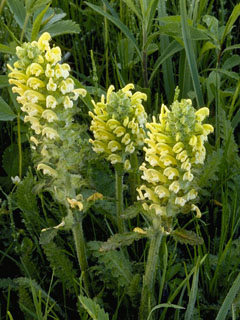
Pedicularis canadensis

The wanderer nodded to the farmer and departed.

------------------
1 "Land walker," wanderer, hobo. The English cognate of "Laafer" is "loafer."

2 "Gribbelschwer" is a debilitating injury to the body resulting from a disease.

3 Lewesgraut, commonly known as Lousewort in English. See discussion below.

Several versions of this tale exist, though the overarching theme of health given in exchange for hospitality runs through all of them.

From the Urglaawe perspective, we are looking at a tale of a visit by the god Wudan, who appears in some tales (explicitly or implicitly) as a wanderer seeking and rewarding hospitality and right action. His simple request for food was exceeded by the farmer's friendly engagement. Thus, Wudan's reward for the hospitality was the restoration of health.

The actual herb used is less clear because multiple names are used in the Deitsch various tales:

Widderkumm (Come Again) = Lousewort (Pedicularis canadensis) or Purple Loosestrife (Lythrum salicaria)

Lewesgraut (Life Herb) = Lousewort (Pedicularis canadensis) or Wood Betony (Stachys officinalis)

The names are complicated further by the English name "Wood Betony" being used for multiple plants, including both Stachys officinalis and Pedicularis canadensis, which are only very distant relatives within the Order Lamiales.

All of these herbs have medicinal value, but the most likely candidate in the context of this story seems to be Pedicularis canadensis, or Canadian Lousewort. Because this plant has parasitic qualities in its relations to other plants, it, at one time, had a unsubstantiated reputation for causing louse infestations in cattle.

Quite to the contrary, Canadian Lousewort has medicinal uses ranging from an aphrodisiac to an anti-tumor to a pot herb to a blood tonic and as a skeletal muscle relaxant... And a bath in a strong decoction can indeed kill lice and scabies.

Thus, we associate the medicinal plants in the Pedicularis family with Wudan as the Herb of Life or Lewesgraut.
Get to know this herb!

Wednesday, August 13, 2014

The First Book of Urglaawe Myths

After three years of engaging in interview, piecing together the notes from those interviews, and connecting dots in our folklore, we are pleased to present The First Book of Urglaawe Myths. There is, of course, a reason that it is called the "first" book; there are still more notes to pore through! Cryptozoological creatures, deity interactions, and ancestor interventions are all here!

This little booklet consists of eight myths, most of which have been published here on the Deitsch Mythology blog in the past. 

All profits from the sale of this book go to Distelfink Sippschaft's operations, which include engaging with the community to find the myths, remnants of myths, and folklore that is critical to understanding the Heathen mindset in the Urglaawe context.

Tuesday, April 1, 2014

Til Eileschpiggel and the Dwarves

Til Eileschpiggel had made a nuisance of himself to the Dwarves so much that they decided that he must be dealt with, so they made plans to drown him. 

They made a casket and placed him inside it, and then they started to trek towards the sea. On their way, they came to a tavern, and they went inside to revel in their victory, leaving the casket outside. 

Along came a herder with a large drove of cattle. When Til heard the approaching hoofbeats, he began to call out, "No! I won't do it! I can't do it!"

The herder stopped and listened to the calls, finally answering, "What is it that you cannot and will not do?"

"They want me to marry the king's daughter, and I won't do it. They are taking me to the king to force me to marry her against my will. I won't do it!"

"Let me take your place," said the herdsman greedily, "I'll marry the king's daughter!"

The herdsman took Til's place in the casket and Til took the cattle towards his own home. 

When the Dwarves came out of the tavern, they took the casket to the sea and sank it. They then headed home joyously.

As they neared the gates of their home, the Dwarves were astonished to see Til alive, and even more bewildered to see him driving a huge herd of cattle towards his home. 

Til said, "Down on the bottom of the sea are many such cattle. These I drove from the bottom and up onto the shore, and I brought them home."

All of the Dwarves, eager to get cattle, ran to the sea and jumped in, heading for the bottom. Not one of them resurfaced.

Monday, March 10, 2014

How Beavers Nixed the Wassernix on Ildechs Grick

Although often considered only a nuisance (and thus seldom given the recognition they deserve), beavers provide many benefits to humanity. Their dams provide a habitat for many sensitive plants and animals. As much as their dams may cause some flooding problems, they can also help to reduce some flooding problems by slowing the flow of water. Also, beaver dams can actually improve water quality.

In this folk tale, our hero is at first annoyed by the sight of the beavers, but, it turns out, he has actually drifted into the middle of a turf war. He finds himself in a dangerous situation, and ultimately discovers that those he considered enemies turned out to be valuable allies.

How Beavers Nixed the Wassernix on Ildechs Grick
Robert L. Schreiwer

Prior to the founding of Baumansdarrif1 and the rise of the coal and zinc industries, Ildechs Grick2 was a significant source of trout for the families of Lower Towamensing. The fishermen shared the creek with a colony of beavers3, though they found the beavers' dam to be annoying when the heavy rains came in April. The dams slowed the movement of water from the Ildechs into the Lechaa4, and the ponding water formed marshes that became breeding spots for mosquitoes.

Early one summer morning, before the sun had fully risen, a poor Kesselflicker5 named Harr Schneider, brought his simple rowboat to the creek. He glanced over at the beavers, who were busy expanding their lodges with mud and sticks. He thought to himself, "If those beavers were not causing the banks of the creek to turn to marsh, I would not have to swat at mosquitoes, and I would not need this boat. I could sit along the banks and fish."

Harr Schneider decided that the beavers must be removed from the creek. He decided that he would bring his gun with him the next day. The thought also crossed his mind that the beavers' pelts would be warm in the winter.

Harr Schneider pushed his boat out into the creek and cast his line into the water. A few minutes later, he felt a bump on the bottom on the boat from the water beneath him. The beavers began to churr loudly, and Harr Schneider suddenly felt that he was in jeopardy. 

Suddenly, a blurry figure manifested itself in the water. It appeared to Harr Schneider like a large gruesome frog. He recognized this creature as a Wassernix6, who would hold his soul as a prisoner in her underwater den if she were to get a hold of him. Panicking, he decided to row back to the marshy bank of the creek. He had no sooner dipped his oar into the water than he heard a loud splash behind him. He turned to see the figure rising out of the water. The creature's appearance shifted from a blurry and scaly green to that more of an old woman. Harr Schneider let out a loud call for help, but no one was near enough to hear him.

The creature stood on the top of the water, and, with one kick, caused the boat to capsize. Harr Schneider tumbled into the water, and the Wassernix grabbed him. Harr Schneider felt as if his soul was being torn from inside of him, and he realized hat he was about to perish.

Just as he was beginning to feel himself slip away, he heard a muffled din within the water. The Wassernix released her grasp on Harr Schneider, and he was able to spring himself from the bottom of the creek back to the surface.

As he coughed and spat water out of his lungs, he looked toward the beavers' lodge. Some of the smaller beavers were slapping the water with their tails, causing the Wassernix to become frightened and disoriented. The larger beavers were swimming in circles around the Wassernix, taking bites at her in an effort to guide her towards one of the lodges.

Harr Schneider swam quickly to the shore, and, once out of the marsh, he watched the beavers continue their attack on the Wassernix, who was now donning her original appearance. The beavers dragged her below the water, and the last Harr Schneider could see of the Wassernix was a blurry form.

Harr Schneider thought to himself, "The beavers took her to a prison like the one she planned for me." He went home and pondered his good fortune.

Every day during that summer, Harr Schneider returned to the marshy water and left the beavers a gift of freshly-cut poplar and birch branches7. He never saw the Wassernix again.

The beavers are gone from the Ildechs, but it is said that their lodges still lie at the bottom of the creek beneath a layer of mud and sediment. Trapped within one of those lodges is the Wassernix, whose plans to trap Harr Schneider were thwarted by her captors.

-----------------

1 Present-day Bowmanstown, PA, which was incorporated in 1808.

2 Lizard Creek in present-day Carbon County, PA.

3 Beaver = Biewer in Deitsch

4 Lehigh River

5 Tinker

6 Water sprite. Wassernixes have some differing personality traits in different tales, but one common theme is that they are generally hostile to humans and animals. They are originally residents of the Unnergegend ("Under Realm") but have acclimated to existence in the Hatzholz ("Hard Wood," the physical plane in which we live), which is why they can appear in spiritual or various physical forms. One of the reasons they are said to trap humans (and, in other tales, animals) is to sap the energies of the  souls in order to be able to continue to shift shape.

7 Poplar is sacred to Berchta (and perhaps Holle and Haerricke), and birch is sacred to Freid (Frigg).

Sunday, November 24, 2013

Ewicher Yeeger

An old Deitsch myth from all across the Blobarrick

By 1732, the Deitsch colonists had entered the area now known as Lynn Township (Lehigh County), Pennsylvania and begun a rapid process of settlement. The settlers cleared huge tracts of land of all trees and brush, and they built farms along the Blobarrick, or the Blue Mountain, and went about their business.

Unfortunately, it did not take long for them to discover that the soil in this particular area was not as fertile as in adjacent areas, and the settlers experienced first a major drought. When the rain did come, it washed away the dry soil, including many of the seeds and the few seedlings that managed to take root. The drought was thus followed by a crop failure. This was a disaster to the folks, who had dubbed the name of their land Allemaengel (also Allemangel or Allemängel), which means "all deficiencies."

The drought and the crop failure were particularly disastrous because much of the wildlife that had lived in the previously forested area had fled to areas still wooded on the other side of the Blobarrick. The situation became more dire as early autumn snowstorms made it impossible to leave the Allemaengel. The colonists became increasingly desperate and began to pray and to set out meager offerings of hay and cloth.

Just as sickness and starvation began to set in, the cold, mid-autumn night's serenity was shattered by a booming voice and an overwhelming sound of barking hounds. The noise seemed to come from nowhere yet from all directions at the same time. The sound appeared intermittently throughout the black of night while the colonists remained in their shelters, frightened by the enormity of the noise.

As dawn approached, the settlers emerged from their homes. They looked out onto the barren fields and saw that the wildlife had been driven back into the Allemaengel. With deer and rabbit suddenly plentiful, the farmers took to hunting and to preserving the meat for the winter.

Throughout that winter, the sound of the hunting pack could be heard across the Blobarrick. The magnitude of the sound never waned, and the folk knew that Ewicher Yeeger (Eternal Hunter) had rescued them from certain starvation. 

To this day in parts of the Blue Mountain from Palmerton to Pine Grove and beyond, when the roaring barks and howls of Ewicher Yeeger's pack are heard, the Deitsch folk know that Ewicher Yeeger continues His errands, keeping the hunting lands of the northwest Deitscherei bountiful.

----------------
Some comments regarding this myth:

Some versions of this tale attribute the importance of scrapple originating in the rabbits being driven over the ridge to save the colonists. The Deitsch word for scrapple is "Pannhaas," which translates to "pan (fried) rabbit."

There are many versions of this tale. In most versions, Ewicher Yeeger is an entity -- or, in Urglaawe, a deity -- of the Earth or the Air. In some other versions, Ewicher Yeeger was originally human but had an unfulfilled oath that kept him at his hunting work.

A well-known depiction of Ewicher Yeeger is J. Allen Pawling's painting, The Eternal Hunter, as seen here in Graeff and Meiser's Echoes of Scholla-Illustrated. Although this depiction does not show antlers or horns, Ewicher Yeeger is often seen as a horned god.

J. Allen Pawling's "The Eternal Hunter"
Despite early attempts to connect Ewicher Yeeger with Wudan via the concept of the Wild Hunt (Fogel 13), most reports of Ewicher Yeeger present an earth-borne feel to this powerful deity. In both Braucherei and Urglaawe, Ewicher Yeeger and Wudan are considered to be two very different gods. In Urglaawe, Ewicher Yeeger is considered to be of the Wane and is believed to be the consort of Holle. Additionally, the Wild Hunt takes place in the skies and in the ethereal space among the realms, and the targets of that hunt are the souls of the departed. Ewicher Yeeger's hunt is bound to the physical world.

Ewicher Yeeger is, though, on errands that exceed our understanding, and it would be easy for one to find oneself beneath the hooves of His horse or captured by His hounds. He is considered in Urglaawe to be a very old deity and is believed to be the god Holler (akin to Norse Ullr (maybe ?) or perhaps is even the Tuisto referred to in Tacitus' Germania) in the context of a regional understanding. Holler traditionally is viewed as a god of death, disease, and destruction, which would seem counterintuitive to the story that such a god would save the colonists from the elements for which He is best known. 

The way to interpret the lessons from this story emerge from Braucherei and Urglaawe philosophy.  The lore on Holler is scant, and much of the negativity associated with Him could be the result of demonization of Teutonic deities, much as Berchta was highly maligned in post-conversion Germanic lore. However, there are clues in most versions of this story that are passed among Braucherei and Hexerei practitioners that can help to explain Holler's role in this myth. 

Allemaengel has a longstanding association with "sorcery" (Smith 2), which is actually a reference to  Braucherei and/or Hexerei, so it is possible that the concept of the Zusaagpflicht was known to some of the people in that area. Many versions of this story make it clear that the settlers did not clear the land responsibly or check the soil prior to building their farms. There are no direct statements regarding to whom the prayers or the offerings were directed. Theories include the self-evident Christian deity, but other theories suggest that the offerings may have been to the land itself or, due to the strong presence of Hexerei practitioners, perhaps even to Teutonic deities. 

The residents of Allemaengel had violated the Zusaagpflicht (Tobin, Sacred Promise, 14, 16) by not caring for the land in which they were settling. The removal of all brush made the land prone to erosion, and the lack of food for the wildlife drove the game away. The resulting death, disease, and destruction were of the colonists' own making. However, the given offerings and uplifted prayers (regardless of to whom they were presented)  showed remorse and a recognition for the settlers' misdeeds. The offering of hay, in particular, can be viewed as a Schild payment to the land for the abuse thereof.

Thus, from the Urglaawe perspective, the colonists had made amends for their misdeeds and appealed for help from the divine. In this case, Holler, a god of wild game, came to their aid. The lesson of the Zusaagpflicht and the interdependence of all living things on Earth is a core Braucherei philosophy that has been in place much longer than the current era's "green movement." Stewardship is a core Urglaawe virtue that ties into the Zusaagpflicht. 

Regarding the sound of Ewicher Yeeger's pack: much like Heathens do not see Dunner (Thor) as the personification of thunder, we also do not see the reverberating sound that is associated with Ewicher Yeeger as being the Eternal Hunter Himself. Instead, we perceive His power in the sound and in the memory of the successful settlement of the region. Thus, much like the natural phenomenon of thunder is explainable by science, so may Ewicher Yeeger's sound be attributed scientifically to a wind of warm air on the cold mountains or to flocks of migrating geese (Gehman 52). However, because the deity does not emanate from the phenomenon and vice versa, there is no conflict between the sensation of the deity's presence and the scientific understanding of the world around us.

Although some similarities have been drawn between Herne the Hunter and Ewicher Yeeger, I have only found one other reference to Ewicher Yeeger in European lore, and it was an obscure Swiss German reference that I have not been able to find again (perhaps our cousins and friends in Europe can direct us to additional sources). The large number of stories in Pennsylvania related to Him, though, indicate that He has been well known in much of the Deitscherei well into present times.

The myth of Ewicher Yeeger brings to mind sections from a particular passage in Dennis Boyer's Once Upon a Hex (23-25) relating to the comments of a retired history professor in Mannheim, Germany:
"You Pennsilfaawnisch Deitsch took something with you. Something that both haunts and protects you. And you left us poorer for it. This has been a troubled land. When our German tribes displaced the Celts, the celtic spirits rested uneasily at first. But the celtic widows and orphans were absorbed into our tribes and brought some of the ancient magic into our midst.'
'When the Romans came, the bloodshed stirred up the old spirits and added fresh souls to the porridge. Confrontation, then absorption into the mercenary machine, and the end of our tribal identity.'

'Next, Christianity with God's message of peace and man's brutal distortions. A time of forced conversions and mass executions. Still, the old spirits stirred and welcomed the new energy into the mournful pool.'

'Then the push and pull of the so-called Dark Ages. There were tranquil periods when new gods of progress faded from the backwaters and left the people to the old rhythms of the land. So in between the temper tantrums of bishops and the greedy predations of feudal lords, the old spirits dwelt among the peasants. Those spirits infused the old wise ones with healing energy and food for the soul.'

'But the growing institutions of church and state needed to feed their appetites for control. So we came out of the Dark Ages and into the darkness. The endless wars, the plagues, the religious hysteria, and "witch" killings, and the peasant revolts and the slaughter at Münster, the quests for territorial dominion under the cover of Catholic-Protestant strife, and the persecution of the anabaptists.'

'It was the time when the old rhythms started to unravel. It was the time when the old spirits cried out at the murder of the old wise ones. It was the time when the stage was set for your people's departure.'
'In pockets along he Rhine, in Alsace, and in Switzerland, some of the old ways and old spirits hung on, biding their time. When the New World was opened to the people of the Rhineland, the impulse of these spirits made it inevitable that the humans in touch with them would burst out of their confinement.'

'I believe there is a spirit essence within a people. It is forged out of their diverse predecessors and out of their common suffering. It is not a ghost that haunts them. It is their way of haunting others.'

'It was that protective capacity the emigrants took with them. They took our best spirits, our ghosts of laughter, and our healing presences. And the last century makes it obvious that we were left more vulnerable when we lost these things.'

'We had stone quarry spirits and woodsmen spirits, spirits of the rye and barley fields, ghosts of grist mills and blacksmith forges, and even a turnip spirit. They all went to Pennsylvania...'

'But we are getting close to a new time. Many of the old German things seem to want to come back to us. Maybe you can help us find these old ghosts. If you want to find them, go back to the beginning of the Pennsylvania experience. They traveled with the emigrants in tool boxes, dowry chests, crocks, and seed packets."
Perhaps Ewicher Yeeger is one of these old "ghosts" - a deity whose new time is nigh. Current Urglaawe theory draws connections to the god Holler (perhaps also the Scandinavian Ullr), and that relationship will be explored in later posts.

----------------
REFERENCES

Adams, Charles J., III. Haunted Berks County. Reading, PA: Exeter House Books, 2005.

Boyer, Dennis. Once Upon a Hex. Oregon, Wisconsin: Badger Books, 2004.

Fogel, Edwin Miller, Ph.D. Beliefs and Superstitions of the Pennsylvania Germans. Millersville, PA: Center for Pennsylvania German Studies, 1995.

Gehman, Henry S. "Ghost Stories and Old Superstitions of Lancaster County." Pennsylvania Folklife vol. 19, no. 4, pp. 48-53. Lancaster, PA: Pennsylvania Folklife Society, Summer 1970.

Graeff, Arthur D. and George M. Meiser, IX. Echoes of Scholla—Illustrated. Kutztown, PA: The Berksiana Foundation, 1976.

Polley, Jane, ed. "Homely and Earthy Talk: Pennsylvanians from Germany." American Folklore and Legend, pp. 28-29. Pleasantville, NY: Reader's Digest Association, 1978.

Smith, Norman A. "Der Alt Hexa Zehner." The Pennsylvania Dutchman, vol. 1, no. 17, p. 2. Lancaster, PA: The Pennsylvania Dutch Folklore Center, August 25, 1949.

Tacitus, Pubilius Cornelius, translated by Herbert W. Benario. "Germany." Agricola, Germany, and Dialogue on Orators, pp. 63-88. Indianapolis: Hackett Publishing Company, Inc. 2006.

Tobin, Jesse. Der Braucherei Weg [CD; 12-month course]. Kempton, PA: The Three Sisters Center for the Healing Arts, 2008.

Tobin, Jesse. "The Sacred Promise at Erntedankfescht." Hollerbeier Haven: Newsletter for Herbal and Healing Arts, v. 1 no. 2, pp. 14, 16. Kempton, PA: Three Sisters Center for the Healing Arts, August 2007.

Wentz, Richard E. Pennsylvania Dutch Folk Spirituality, pp. 300-302. New York: Paulist Press, 1993.

Yoder, Don, ed. "A Legend of Alle-Maengel." The Pennsylvania Dutchman, vol. 1, no. 12, p. 5. Lancaster, PA: Pennsylvania Dutch Folklore Center, July 21, 1949.

----------------
Please use the following information when citing this article:

Schreiwer, Robert L.. Ewicher Yeeger. deitschmythology.blogspot.com, November 24, 2013. Bristol, PA: Deitscherei.com, 2013.