Pages

Sunday, May 8, 2016

Wonnenacht and the Wonnezeit

This myth is a product of the Folklore Research Project and represents tales and fragments of tales related principally by folks who identified themselves as practitioners of Hexerei and Braucherei. Some segments of the story were also known to individuals outside of the practices. The term Wonnenacht ("Night of Joy") has been seldom used historically, but it has become the principal term for Walpurgisnacht in Urglaawe. The term Wonnedanz ("Dance of Joy") was related by a Hex from Montour County, PA, and is a replacement for Hexedanz (Witches' Dance), and Wonnezeit ("Time of Joy") describes the twelve-day observance.

Wonnenacht represents the transition from the Dunkelheft (Dark Half of the Year) to the Brechtheft (Bright Half), and the observance welcomes Holle upon Her return from the Wild Hunt.

WONNENACHT AND THE WONNEDANZ


As Sunna's kiss brought increasing warmth and light to the Hatzholz (Heartwood; the physical realm), Holle sent for her ever-loyal servant, Gedreier Eckhart, whose job it was to walk ahead of the Parade of Spirits to warn the living of the fury behind him. Eckhart's love for Holle is as great in death as it was in life, so he flew into the midst of the Host, finding the goddess dressed in white and seated in a wagon being pulled by the souls of nine bulls. The wagon rolled on three great spinning wheels. From each wheel spun a multicolored thread that wove with the the thread from the others, forming a sack of infinite size named Immerraum ("always-room"). The thunderous voices of many found spirits within the sack resounded across the realms.

"I have filled the sack that cannot be filled, and it is time to bring them home," Holle said. "Go forth to Mannheem (the home of humanity within the Hatzholz) and tell the living that they may welcome the Host and that they should be prepared for the visit. Those who remembered and honored my word will be rewarded. After the visit, they are to light two fires and to pass between them. Through that action, they will be renewed. Then you are to go to the Mannheem field, where you will find a lone linden tree under which you may rest until I arrive.”

As Eckhart began his journey into the Hatzholz, announcing the return of the Great Lady, Holle took her mighty Sichel (Sickle) and cut the three threads each, using the end of the strands to tie the sack shut.

The Host crossed from the Oschtbledder (Eastern Leaves) into the Hatzholz. Throngs of people, though scared at first, came out to welcome the parade, honoring the arrival of the wondrous Lady. The clamor of spirits filled the high skies as Holle entered Mannheem. The bulls pulled Her wagon through open windows and doors, seeking those who welcomed Her. The orderly homes served as a sign that Her command was obeyed. She filled the homes with bright light that brought such joy to the residents that they broke out in song and dance.

Presently the wagon approached the Mannheem field called Hexefeld, where Holle found Eckhart sleeping within the bark of a linden tree. She sent the southwest wind, Riffel,1 to awaken him. She instructed Eckhart to lead the Host to Hexefeld and, upon arrival, to cut loose the spirits in the sack. "It is time to meet my sister," she stated.

Eckhart did as he was told. As the Host of the cosmic spirits approached the field, Eckhart saw another parade descending from the clouds, emerging from the forests, and coming from the soil. Ahead of this parade was a brilliant gray light radiating from a beautiful elderly woman who was also dressed in white. Eckhart approached the woman, recognizing Her as Berchta, and he bowed before Her. He then took the lead through the countryside as the two parades merged together and drew closer to the linden tree where Holle awaited them.

A hush fell upon the Host as the two sisters greeted one another. They embraced, and they began to spin in a dance. The dance spun gentle whirlwinds that touched the Host, bringing warmth and joy to the spirits of the Host, and they, too, began to dance. Some gathered strands and dust from the sack, streaming the strands around trees and scattering the dust on the ground.

The Sisters continued to dance with the Host dancing behind them, moving from the field and over the rivers and lakes. Every being in the water began to dance for joy. The whirlwinds spawned gentle rains that awakened the spirits in the sleeping plants, and they, too, began to dance for joy.

The Dance moved to the foothills, where the Frost Giants had taken refuge from Sunna's breath. As the Host approached, the winter vanished, forcing the Frost Giants to retreat.

On the twelfth day, Holle instructed Eckhart to sleep in a rock at the base of a mountain pillar while the dance continued up a ridge called Hexenkopf. The entourage eventually stopped by a marshy wellspring near the top. The two sisters took rest by the wellspring, and the spirits began to feel drawn to its depths.2

Holle and Berchta commanded the Host to continue their journey to its end by Holle's home.

Holle led one half of the parade to an elder bush, the roots of which reached beyond the Hatzholz and into the dark realms, taking nourishment from three creeks named Schprudlendi, Gwellendi, and Fliessendi.3 Berchta led the other half to the depths of the wellspring, which emptied into the same creeks.

THE MILL

The spirits followed the goddesses into these creeks and surfaced in the Holle's meadow, named Bollwies (Flax Meadow), in the Dunkelgegend.4 The spirits followed the goddesses through some woods, passing Holle's home, Es Heisli. They soon entered an open field called Weiwerfeld and soon approached Her Mill.

Holle unhitched the bulls from Her wagon and yoked them to a giant millstone named Seelbrecher ("Soul Crusher"). Behind Berchta, the spirits lined up and entered the Mill, where they would be split apart, never to return in their present form. Holle returned to the joyous Mannheem, taking Her seat upon the Hexenkopf pillar while Eckhart sleeps in a rock.5

BERCHTA LEADS FORTHCOMING SOULS TO UNNERGEGEND

On the other end of the mill, the kernel of the selves of each soul emerged behind Berchta, who then led them up the world tree to the Unnergegend. There they take full form and await their return to the living realms.6

Thus, the Bright Half of the Year began and order was restored to Mannheem. King Frost, fearful of losing his grip on the valuable realm, sent his armies to attack.7

1 In this story, the wind is coming from the southwest; in another myth, the wind directions are known by their destination rather than their origin. Thus, it is possible that the southwest wind in this myth is known by the name of the northeast wind in the other myth.

2 Magnetite was/is common at Hexenkopf and was eventually mined. The most familiar ponds at Hexenkopf currently are ore holes resulting from the mines, but there are also marshy water holes naturally on the mountain that may serve as the reference to the wellspring.

3 The names of the wells translate to Brimming, Bubbling, and Flowing.

4 The Dark Realm

5 There are reports of a White Lady approaching walkers, carriages, and cars along the top of the pillar, particularly around Walpurgisnacht.

6 There is more to this segment to appear in the next version.

7 This is a connection to the Butzemann traditions and the myth of Dunner and the three Frost Giants, Dreizehdax, Vatzehvedder, and Fuffzehfux. At least two versions story have been described frequently under separate cover but will be harmonized either in the next version of this myth or in a separate myth.

Wednesday, December 30, 2015

Berchtaslaaf

For folks who identify with Urglaawe, there is a meal requirement on Twelfth Night (December 31, the Feast Night of Berchta), of herring, gruel, and Zammede (pancake or dumpling). More Heathens in different traditions are also beginning to adhere to that requirement. See Grimm's "Teutonic Mythology," volume 1, p. 273 (among other references in the work):

Berchta, like Holda, has the oversight of spinners; whatever spinning she finds unfinished the last day of the year, she spoils. Her festival has to be kept with a certain traditional food, gruel and fish. Thor says he has had sildr ok hafra (herring and oats) for supper...; our white lady has prescribed the country folk a dish of fish and oat-grits for evermore, and is angry whenever it is omitted (Deutsche sage, no. 267). The Thuringians in the Saalfeld country wind up the last day of the year with dumplings and herrings.

This meal on Twelfth Night stands in stark contrast to the meal of Twelfth Day (New Year's Day), which is the ornate pork and sauerkraut of old Pennsylvania German traditions. Juxtaposing the end of Yule's darkest times with the beginning of the New Year reminds us of our hopes and dreams for the future.

Also, the need to complete all spinning tasks before December 31 appears as a "superstition" in various regions. 

Blessed end of Yule to all, and best of luck in 2016!

Monday, April 13, 2015

Der Schlangkeenich - The Snake King

Features:

The general word for "snake" in Deitsch is "die Schlang," thus, a snake is grammatically feminine.

One reference to the "Schlangekeenich" is translated as "snake queen" rather than "snake king," perhaps due to the use of the term "Keenich" rather than "Keenichen" (or "Keenichin") for "queen bee" in most variants of Deitsch. This reference appears in Richard Wentz's "Pennsylvania Dutch Folk Spirituality" (p. 199). Despite the gender difference between Wentz's reference and the clear reference to a King in this version, other features are identical. For example, the "snake queen's" whistle will rally all snakes "to waylay and fight the wayfarer." This whistle is reflected in the folk tale.

Additionally, there is also a tale called "The Snake King" in the diaspora in Ontario in W. J. Wintemberg's "German Folk Tales Collected in Canada" (Journal of American Folk-Lore, p. 243, 1906).

Phares Hertzog has a article titled "Snakelore in Pennsylvania German Folk Medicine" in "Pennsylvania Folklife" vol. 17 no. 2 (Winter 1967) pp. 24-26. I have this issue and will dig it out. I do not remember his viewpoints on it.

In addition to dragon-types of creatures like the Snallygaster, here are two cryptozoological snakes in oral lore (Wentz refers to them on p. 199): the Reefschlang (Hoop Snake) and the Hannschlang (Horn Snake). The hoop snake appears in wider American lore.

As is the case with much of the rest of "Teutondom," dragons and serpents guard treasure (see also Henry S. Gehman's "Ghost Stories and Old Superstitions of Lancaster County" in "Pennsylvania Folklife," vol. 19, no. 4 (Summer 1970), pp. 48-53). In the case of the Schlangkeenich, the variants seem to reflect local lore regarding real or legendary resources. Gold appears in one variant. Silver, diamonds, and gems (particularly garnet) appear more frequently.

Braucherei is almost inconsistent when it comes to snakes. Despite many references to "thou, snake, alone are cursed," there are many incantations that call to snake spirits for the removal of poisons, charming, even fertility. As reflected in the story, snakes are simultaneously independent yet fiercely loyal to their King and their den. Another common perspective is that a snake is a snake: not inherently evil or cursed, but it must eat and defend itself as a snake must.

There are several additional folk tales that relate to snakes guarding treasure, though these do not refer to Snake King. They carry some similar themes, though.

DER SCHLANGKEENICH

(Variant B Harmonized - all nine informants were from the area of Palm and Zieglerville, PA - seven of the nine were of Schwenkfelder descent).

Harr and Fraa Keller (name randomly chosen) owned a farm in Franconia (PA). Unfortunately, having been caught placing damaged apples at the bottom of market baskets while placing shiny ones on the top, they had developed a reputation for being untrustworthy and greedy.

One day, Fraa Keller was collecting apples in her field when she spied a small horn-tailed snake (Hannschlang) slithering alongside a rock. Fraa Keller saw what she thought was a mouse in the snake's mouth, so she drew closer to get a better look. As she approached the snake, she could see it was not a mouse but a large garnet crystal in the snake's mouth.

Fraa Keller asked the snake where the garnet came from, and the snake replied that she had been given the garnet as a reward for good service to the Snake King. Fraa Keller grew excited by the idea that the Snake King might have more gems, so she asked where she might seek an audience with the Snake King. The snake responded that she was not permitted to share the location of the den.

Fraa Keller replied that she understood, but she was not about to give up the quest. She asked whether the snake would be willing to trade the garnet for something else. The snake replied that she was thirsty and would welcome a drink, and the hospitality would be rewarded with the garnet.

Fraa Keller ran into her kitchen where she concocted a drink to charm the snake into telling the truth, placing it into a bowl for the snake to drink.1 She then returned to the thirsty snake. The snake dropped the garnet and heartily drank the concoction.

Shortly after finishing, the snake began to feel dizzy, and her vision became blurry. She began to slither back toward the rock, but Fraa Keller stood before her and uttered an incantation.2 The snake panicked but felt a loss of control.

Fraa Keller, having charmed the snake, again asked her where the Snake King could be found. Against her own will, the snake replied with the location. She also added a warning, "Anyone who enters the den and tries to harm the King or to steal his hoard will be buried alive."3

Satisfied with the answer, Fraa Keller released the charm, but the potion had poisoned the snake, and she died.

Fraa Keller took the garnet and ran to her husband. She informed him of the Snake King's hoard, which excited the greed within him, too. Fraa Keller urged Harr Keller to go after the hoard, but, remembering the snake's warning, she advised him to take along a large bag, a beam of wood and a shovel. "After all," thought she, "we would not want the treasure to get buried without tools to release it."

The Kellers went to the location and found a hole wide enough to step into. Fraa Keller did not give it a moment of thought to wonder why the hole was so large when the snake she killed was so tiny. As Harr Keller stepped into the hole, Fraa Keller said, "I will wait for you here to help you out."

Harr Keller stepped into the entrance of the hole. He took one more step and fell into a large pit that was lit only from the sunlight coming in from the hole. However, the sunlight was reflected by garnet crystals that adorned the walls and covered the floor in piles.

Harr Keller began to shovel the garnet from the piles into the bag, but then he heard a loud hiss. A large horn-tailed snake seemed to appear from the wall. Upon his head he wore a gold crown adorned in large, polished garnet.

"You must be the Snake King," Harr Keller said.

The Snake King looked fixedly at Harr Keller and replied, "Yes, and who are you who is stealing my treasure?"

Harr Keller replied with a lie, "Does a snake need treasure? One of your own traded this treasure to my wife for a drink. She has part of the payment in her possession."

The Snake King, being much shrewder than Harr Keller had expected, responded, "Whether a snake needs treasure or not, it is not yours to take, and your claim is a lie."

Harr Keller, recognizing that he was in trouble, took the shovel and attempted to strike the Snake King on the head. However, he hit only the crown, and the garnet deflected the strike. Harr Keller dropped the shovel, and the Snake King slid upon it.

The Snake King let out a powerful hiss that turned into a whistling sound, and all the snakes in his realm heard his call and headed toward the hole. Fraa Keller, hearing the rustling in the grass, sensed danger. She clutched her garnet and abandoned her post, returning to her kitchen.

Meanwhile, Harr Keller tried to hide from the Snake King among the garnet piles. Using his mighty horned tail, the Snake King smashed the piles, causing the crystals to fly through the air, pelting Harr Keller in the face.

The commotion caused the roof of the pit to weaken, and dirt began to fall upon Harr Keller's head. Hiding behind a pile of treasure, he reached for the beam of wood, hoping that it would brace the ceiling.

The Snake King approached the beam, and Harr Keller called out, "If the pit caves in, you will be buried, too."

The Snake King responded, "Does a snake need a pit? My kin and I can dig our own way underground." He then used his tail to smash the beam. The ceiling caved in, burying Harr Keller.

The Snake King dug his way to the surface, where his army of loyal kin awaited him. He told them of Fraa Keller's treachery. He ordered them to seek out the woman with garnet. His army made its way toward the Keller's house, passing in horror the body of their deceased sister.

The Snake King slammed through the kitchen door with his horned tail, which allowed his army to enter. Fraa Keller attempted to utter the incantations against the Snake King, but, before the words could leave her lips, the army set upon her, biting, stinging, and twisting around her.

The Snake King found the traded garnet and, taking it in his mouth, returned to the spot where the first snake had been poisoned. He used the garnet to scratch into the soil, beginning a new den where he and his kin could live in peace.

-----------------------------
1 There are a few of these hypnotic "truth serum" types of concoctions reported, and they would fall under Verbot because of the removal of another's free will normally violates many tenets of Braucherei. I can say a few of the known ingredients often include hemp dogbane, violets and passionflower, but some of the other reported ingredients are potentially toxic to humans.

2 There are quite a few charms for snakes. An example:

Schlangel, Schlangel
Beiss mich net
Hald dei Saft
Bischt du yetz
Unn'r meinre Graft
Schlangel, Schlangel
Saag die Waahret
Zu meinre Frooget

Little Snake, Little Snake
Bite me not
Hold thy juice (venom)
Thou art now
Under my power
Little Snake, Little Snake
Say the truth
to my question

3 Caving in of ceilings, walls, or vaults is not an uncommon theme in Deitsch folk tales that relate to theft.

------------------
Informants (year 2010):

1, 2, 3, 5, 6, 7, 9 Schwenkfelders requesting no identity
4. K. Freed, Montgomery County
8. E. Renninger, Montgomery County

Tuesday, March 10, 2015

Oschdre (Where Color Comes From; Origin of the Distelfink)

-------------- PREFACE --------------

Rob had only heard parts of this when he was younger, mostly from relatives or friends of relatives from the stretch between Ashfield and Bowmanstown (version A), PA but also from the Berwick area (version B).  In 2012, Rob asked around the two areas and got leads on some people who may know about the story, and he ended up with 10 new informants for a total of 17. Other informants were familiar with one or two points of the story but not enough to make a significant contribution. More than half of the informants came from farther south, in a stretch from Orwigsburg to New Ringgold (version C). Their versions of the story bore more information and some distinct contrasts with those of the two northern areas. Thus, this particular myth has undergone some reconstruction using as a base the information that the informants provided. The more important variations are noted with footnotes below.

It should also be mentioned that only four informants (all of whom self-identified as knowing Braucherei or Hexerei), looked at any aspect of this as being anything beyond a metaphor. Informant #11 specifically referred to the three Ladies as "goddesses"; #8 referred to Oschdra as a "helpful entity";  #13 and #15 referred to the sisters as "helpful spirits." Therefore, it cannot be said that this was a widespread myth with religious significance historically, but it is applicable to the modern perspectives of Urglaawe.

It is also by no means certain that this is of any particular antiquity; it may be a story that arose in the foothills since the settlement. Thus, it is prudent to encourage readers to look at this as a new myth or a reconstruction or a retelling of a regional folk tale while allowing individuals or kindreds to view it as they will.

Michelle A. Jones and Robert L. Schreiwer

-------------- DIE OSCHDRE --------------

Three sisters, Helling, Nacht, and Oschdra,1 gathered together at a point on the world they called East,2 Each sister wore a cloak of transformative power. Helling wore a cloak of light; Nacht, a cloak of darkness; and Oschdra wore a cloak that could not been seen. They decided to meet at this moment because they were bored with the blandness of existence and wished to make it all appear more interesting and exciting.

Nacht stepped forward first and as She did so, Her cloak covered the world and everything beneath Her and it became black. Oschdra, seeing what happened when Her sister progressed, moved forward next. Only this time, Oschdra’s cloak seemingly had no effect on the world below. Next Helling walked forward, and as She did, the world below Her and Her cloak was cast in white. Most amazingly, as Helling’s white touched Nacht’s black under where Oschdra stood, Oschdra's cloak and everything below Her transformed and could now been seen in a new shade She called "gray."

Oschdra then called upon a pair of Finches,3 Distelfresser and Himmelflucht,4 to fly from Her right hand, a place She called North, to Her left hand, a place She called South. As they would make their flight, everything in their path would be washed in gray.

Distelfresser and Himmelflucht agreed, but asked Oschdra to grant them a simple request: Himmelflucht’s eggs shall also be gray so that she could see them regardless of Helling or Nacht being above them. Oschdra happily granted their request, and the Finches began their flight.

The three Sisters continued their walk around the world. Nacht providing the black hue, Helling, the white, and Oschdra, gray. After nine days, Oschdra became restless once again. She was unhappy that she could only create a tint on the world by standing between Her sisters. She wanted to provide Her very own hue. She looked upon Her cloak and closed Her eyes. She imagined one side of the cloak afire with a varied warm glow and She called it red, orange, and yellow. She imagined the other side luminescent with a cool iridescence and She called it green, blue, and violet.

Oschdra opened Her eyes, and now Her cloak bore all these hues which she called “Farewe,” but in Her own tongue.5 Now as Oschdra walked from the East to the West,6 the skies radiated with the new colors. Her sisters saw the change, and they admired Oschdra’s craft.

Together the three Sisters of the East, thenceforth known as the Oschdre, decided to do more. Helling added white to the colors and Nacht added black. Oschdra’s palette grew and the Sisters loved their work.7 The colors appeared in the sky but not elsewhere in the world. Oschdra and Her Sisters wished for the whole world to emerge with the colors of their work so they sought the assistance of the most prolific of the animal world to help them with their work. They found Haas8 and asked him to transform the world wherever his tail went by saturating everything in its path with the colors of the Ladies' craft. Haas agreed but asked in return that all of his descendents would inherit his role as the bearer of color.

The Oschdre Sisters agreed. While Helling and Nacht stood opposite one another, Oschdra sent Haas forth. Haas was directed to begin at the nest of the Finches, who, having completed their journey, were now flying South to North. Oschdra declared to Himmelflucht, “With Haas' colors, your eggs will always be in your sight.”

Just as Hare painted the last of the eggs,9 Distelfresser landed in the nest to check on them and he was pleased. Haas' tail brushed against him as Haas was leaving and Distelfresser’s plumage transformed to vibrant yellow, blue, green, and red.10

Haas continued on his way, and to this day, wherever Haas goes, color follows his tail.11

-------------- NOTES --------------

1 Only two informants (#13 and #15, both of the New Ringgold area; version C) had names for all three of the ladies: Helling ("Daylight"), Nacht ("Night"), Oschdra ("of the East"). The northern versions (A, B) only listed one individual, the Lady of the East, Oschdra, rather than three. Others in the southern stretch (C) knew one name or another or simply referred to them as "Schweschdere" (sisters).

2 Informant #10 referred to the Lady's home as "Mariyeland" (sometimes spelled "Maryeland"), which could be influenced by the Deitsch name for Morgenland (Lehigh County) and literally means "Tomorrow Land," referring to the East.

3 There is a distinct difference in versions here. Version A refers to a goose while version C refers to a pair of finches. Version B makes no mention of this at all. Rob initially went with the goose route because that was the version he was most acquainted with. However, the goldfinch has as many informants and all of the informants from the area of version C indicated some knowledge (albeit in some cases passive) of the finches being part of the story.

4 Informant #13 (version C) was the sole provider of the names of the finches, and she had stammered significantly on the male's name as she tried to remember what her father had related to her. She ultimately provided Distelfresser ("Thistle-Eater") and Himmelflucht ("Heaven-Flight") as the name of the female. As these were the only names provided, we used them.

5 Whatever word a goddess would use in the language of the Hohegegend (the realm of deity) that would be the equivalent of Farewe ("colors").

6 Almost every informant in versions A and C reported this "walk" from the East to the West. Version B was more simple in a reference to the dawn bringing the colors.

7 Version A included mixing them together to form the earth color brown.

8 Haas ("Hare"). It should be noted that the purpose of the story as related in version B by informant #7 was to explain where the Easter Bunny came from, and the colors were more a secondary tale. In version C, it was the opposite; the purpose of the story was to explain where colors, including those of the Distelfink, came from. Version A fell somewhere in between with more focus on the origination of the colors of the world.

9 This is where the difficulty with version C comes in as the most typical reflections of eggs at Oschdre/Easter are goose eggs and chicken eggs. The only relatively widespread association with smaller bird eggs are those of Robins, who are announcers of springtime in Deitsch lore. The variety of colors and shades among house finch eggs, though, is not to be dismissed. And, also, sometimes a metaphor is just a metaphor.

10 There was some disagreement among the version C informants of this segment. Two informants stated yellow and called it Distelfink.. two stated yellow and red and called it Distelfink... and three related yellow, blue, green, red and called it by both Distelfink and Bird of Paradise. It is anyone's guess whether any of these was the original version or any/all were an alteration to the story to reflect the artistic concepts of the Distelfink/Bird of Paradise depictions. The one conclusion we do draw from this particular tale, though, is that Distelfink got its colors from Haas on his mission to paint the world. Stressing again: It is also by no means certain that this is of any particular antiquity; it may be a story that arose in the foothills since the settlement.

11 This is probably the most widespread portion that people in general remember, even if vaguely, outside of the informants on the list.

Thursday, February 19, 2015

Lewesgraut - Herb of Life

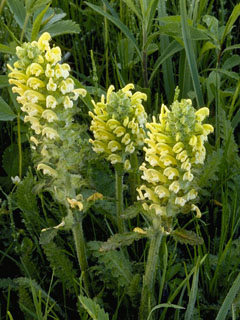
One day a Landlaafer1 arrived at a farmhouse seeking food. The farmer, who was crippled by an old injury2 from a disease, invited the wanderer in and offered him food and drink. The farmer sat with the wanderer, and the two talked as if they were old friends.

When the wanderer finished his meal, he said, "You have been kind to me. In return for your hospitality, I will bring you a plant that will bring you strength." He left the farmhouse and returned later holding the plant.

"This is the Herb of Life.3  Use it to restore your health."
Pedicularis canadensis

The wanderer nodded to the farmer and departed.

------------------
1 "Land walker," wanderer, hobo. The English cognate of "Laafer" is "loafer."

2 "Gribbelschwer" is a debilitating injury to the body resulting from a disease.

3 Lewesgraut, commonly known as Lousewort in English. See discussion below.

Several versions of this tale exist, though the overarching theme of health given in exchange for hospitality runs through all of them.

From the Urglaawe perspective, we are looking at a tale of a visit by the god Wudan, who appears in some tales (explicitly or implicitly) as a wanderer seeking and rewarding hospitality and right action. His simple request for food was exceeded by the farmer's friendly engagement. Thus, Wudan's reward for the hospitality was the restoration of health.

The actual herb used is less clear because multiple names are used in the Deitsch various tales:

Widderkumm (Come Again) = Lousewort (Pedicularis canadensis) or Purple Loosestrife (Lythrum salicaria)

Lewesgraut (Life Herb) = Lousewort (Pedicularis canadensis) or Wood Betony (Stachys officinalis)

The names are complicated further by the English name "Wood Betony" being used for multiple plants, including both Stachys officinalis and Pedicularis canadensis, which are only very distant relatives within the Order Lamiales.

All of these herbs have medicinal value, but the most likely candidate in the context of this story seems to be Pedicularis canadensis, or Canadian Lousewort. Because this plant has parasitic qualities in its relations to other plants, it, at one time, had a unsubstantiated reputation for causing louse infestations in cattle.

Quite to the contrary, Canadian Lousewort has medicinal uses ranging from an aphrodisiac to an anti-tumor to a pot herb to a blood tonic and as a skeletal muscle relaxant... And a bath in a strong decoction can indeed kill lice and scabies.

Thus, we associate the medicinal plants in the Pedicularis family with Wudan as the Herb of Life or Lewesgraut.
Get to know this herb!

Wednesday, August 13, 2014

The First Book of Urglaawe Myths

After three years of engaging in interview, piecing together the notes from those interviews, and connecting dots in our folklore, we are pleased to present The First Book of Urglaawe Myths. There is, of course, a reason that it is called the "first" book; there are still more notes to pore through! Cryptozoological creatures, deity interactions, and ancestor interventions are all here!

This little booklet consists of eight myths, most of which have been published here on the Deitsch Mythology blog in the past. 

All profits from the sale of this book go to Distelfink Sippschaft's operations, which include engaging with the community to find the myths, remnants of myths, and folklore that is critical to understanding the Heathen mindset in the Urglaawe context.

Tuesday, April 1, 2014

Til Eileschpiggel and the Dwarves

Til Eileschpiggel had made a nuisance of himself to the Dwarves so much that they decided that he must be dealt with, so they made plans to drown him. 

They made a casket and placed him inside it, and then they started to trek towards the sea. On their way, they came to a tavern, and they went inside to revel in their victory, leaving the casket outside. 

Along came a herder with a large drove of cattle. When Til heard the approaching hoofbeats, he began to call out, "No! I won't do it! I can't do it!"

The herder stopped and listened to the calls, finally answering, "What is it that you cannot and will not do?"

"They want me to marry the king's daughter, and I won't do it. They are taking me to the king to force me to marry her against my will. I won't do it!"

"Let me take your place," said the herdsman greedily, "I'll marry the king's daughter!"

The herdsman took Til's place in the casket and Til took the cattle towards his own home. 

When the Dwarves came out of the tavern, they took the casket to the sea and sank it. They then headed home joyously.

As they neared the gates of their home, the Dwarves were astonished to see Til alive, and even more bewildered to see him driving a huge herd of cattle towards his home. 

Til said, "Down on the bottom of the sea are many such cattle. These I drove from the bottom and up onto the shore, and I brought them home."

All of the Dwarves, eager to get cattle, ran to the sea and jumped in, heading for the bottom. Not one of them resurfaced.