Pages

Showing posts with label Pennsilfaanisch Deitsch. Show all posts

Tuesday, August 13, 2019

Die Mechdich Lechaa

All hail the Mighty Lehigh!
Low tide on the Lehigh by Jim Thorpe, PA
Great western river of Lenapehoking!
At low tide even does your spirit reach

From the rocks to the sky and beyond.

Great nourisher and benefactor
Your calm waters cede to rapids.
Your serene nature becomes fury.

Well known to us as die Lechaa,
You took us into your bosom.
You blessed the fields of the Deitsch,
And quenched our thirst for freedom.

The canal crews feared your swells,
Even while depending on you
For sustenance and livelihood.
Dumping soot and ash
Into your holy stream.
Yet you forgave us.

Your beauty never faded,
And You have regained power.
Oh, Mighty Lehigh!
Mechdichi Lechaa!
May we be worthy of your gifts.

                             - Robert L. Schreiwer, 2019

Monday, December 31, 2018

Coins on the Windowsill

A common Deitsch tradition tonight is to put a coin (or coins) outside on your windowsill overnight tonight. 

Some variations specify that the coin/s should be silver. Others specify three denominations (nickel, dime, quarter, etc.) of coin. Some Christian interpretations are that these are for the Magi on their way to Bethlehem (PA? lol), while other interpretations definitely have this related to magic that easily fits in with Berchta making the rounds as a beggar. 

If the coin/s are still there in the morning, bring them back in and "Was hawwich yetz wa ich ganzes Yaahr haawe." ("What I have now I will have all year.") 

If the coins are gone, then the need was greater elsewhere, and you will receive good luck for aiding another.

Tonight is Berchta’s feast night, and Urglaawer are preparing for Her requires meal of herring and gruel or Zammede (pancakes made only of flour and water).

Halliches Nei-Yaahr!

Sunday, September 16, 2018

Shaking the World

This week, minor earthquakes with epicenters in Berks County rattled the heart of the Deitscherei, so it is time to revisit some scant references that had grown cold over the years. Although the names were usually unknown to folks with whom I had spoken, more people knew of an "Earthquake Giant" ("Erdbewung-Ries") as a concept.

There are at least three named "earthquake Giants" from different regions: 
  • Der Bollerfuus ("rumble foot") was said to live within the Montour Ridge near Mausdale, PA, in Montour County.
  • In a similar manner, Der Gerumpelfuus (also translating to "rumble foot") was said to live in Raccoon Mountain near Williamsport in Lycoming County, PA.
  • The third, der Zidderfuus ("tremble foot") has no designated home but was actually the name reported around the Lancaster Seismic Zone, which is the region with the most seismic activity in Pennsylvania. 

In the case of their more recent activity, they were said to have been asleep but were re-awakened by human actions, particularly, whether accurately or not, by fracking or by wastewater disposal. In an angry state, they were said "to shake the world around" ("die Welt rumzuschiddle").

Monday, January 8, 2018

Gedreier Eckhart: Germanic Psychopomp?

Gedreier Eckhart is one of the more interesting characters in our folklore. For me personally, this is partially because Eckhart is a family surname and also because, somehow, much of my family was aware of the connection between Eckhart and Holle while I somehow did not make the connection until I fully identified as Urglaawer. Weird.

Eckhart [Source: WikiMedia Commons]

There is not a huge volume of oral lore on him from Deitsch lore, but what we do have makes him an important player in the Urglaawe view of the Wild Hunt. Our lore is consistent with much of the lore of other German lands as well.

Eckhart’s roots run deep in Germanic lore. He is of the war band of Dietrich of Bern. He appears as Eckewart the Margrave in the Nibelungenlied, and in a Heldenbuch appendix, he is said to stand before the entrance to Holle’s realm to warn or to frighten away anyone who wished to enter. He also appears in the Middle Ages tale of the Tannhãuser, and Grimm (936) postulates that he was perhaps functioning as a Heathen priest. In our lore, he may have been an incarnation of die Weisskeppich Fraa  (but that sense appears to be an outlier).

Eckhart is a loyal character throughout the heroic legends, but, in Deitsch lore anyway, his title of Gedreier (“Loyal”) comes from his dedication and service to Holle. He appears with a white beard and a white staff. He is deceased, yet he continues to serve the goddess in death just as he did in life. Our lore places him as sleeping in a linden tree or in a rock until Holle has need of him. In Germanic lore, including that of the Deitsch, he precedes the Geischderschtrutz, or the Parade of Spirits (read: the Wild Hunt), warning the living to get out of the way of the impending fury and also advising the living to be prepared for Holle’s inspection.

As the Parade continues and, as Deitsch lore says, meets up with Berchta and the souls of those who have passed since the Hunt began, Eckhart guides the souls of the Parade to Holle’s Mill, where they are crushed into separate parts and reconstituted into new soul constructs. 

In this sense, it appears that Eckhart is very much functioning as a psychopomp, guiding the souls of the deceased to the end of their journey. 

I have been playing the role of Eckhart in Philadelphia’s Parade of Spirits for several years, and I have been reflecting that psychopomp role without giving it due consideration. This year, I intend to make that role more pronounced.

Friday, March 3, 2017

Der Luul

'Siss Midwinder. Viele vun de Blanzegeischder sinn uff der Wilde Yacht mit der Holle gange. 'Em Reifkeenich sei Griegsmenner sinn iwwer 'm Land am Haerrsche. 

Wie waer's doch mit de annere Blanzegeischder? Sie sinn immer am Schiddle im reifiche Bodde. Wann en Eisgrieger die sehnt wett, er deet die in die Unnergegend schicke.

Wie duhne die driwwerkumme?

Der grie Harr Luul hiedt die.  Sei Ochdem erbaeht die. Sei Hand beschitzt die. Die yingere Geischder  buhle um sei Gunscht vun Ihm. Er iss die Waerming im Kalt. Er iss em Daagslicht sei Suh. Er iss der Lenzing im Winder.

----------------- 

It is midwinter. Many of the plant spirits are on the Wild Hunt with Holle. The warriors of King Frost rule over the land. 

What of the other plant spirits? They are always shivering in the frosty soil. If an ice warrior would see them, he would send them to the Unnergegend. 

How do they survive?

The green Lord Luul watches over them. His breath warms them. His hand protects them. The younger spirits court his favor. He is the warmth in the cold. He is the son of the dawn's light. He is the spring in winter.

----------------- 

One of the more mysterious beings in the Hexerei lore related from Central Pennsylvania by a small handful of respondents, the Luul is the defender of the winter greens and the early spring greens. 

The respondents related to Him as a helpful entity, which is not uncommon among many practitioners of Deitsch folk healing and magic even with known deities such as Wudan, Dunner, and Holle. The text above is an amalgamation of several respondents' statements, but among the more curious comments was from a Sadie M. (not her real name) of Juniata County, who made the specific reference to Luul being the son of dawn's light and the "Lenzing" in winter.

Lenzing can mean "springtime," but it is also an alternate name for the month of March (and is of the same root as "Lent" and is of Germanic origin). March is also the time of the Spring Equinox, or the Oschdre, which is associated in other tales with a goddess of the dawn who brought color to the world. Could Luul be the son of this goddess? 

During discussions on this topic among the Urglaawe community, we learned of the Frankish god known by varying names, including Lollus, Lullus, and Loll. We have looked into a possible link between Luul and Lollus. Lollus is depicted as holding His tongue, presumably because He is youthful (maybe even “Baby New Year” youthful?). Indeed, His name is linguisticlally related to “lollipop” and “lullabye,” so the tongue and the mouth appear to be important features.


Some scholars link Luul to Frey in terms of fertility. Grapes and earns of grain were given to Lollus, and He wore a wreath of poppy flowers around His neck. 


Image Source:
https://www.schweinfurtfuehrer.de/sagen-und-geschichten/schweinfurter-sagen/die-sage-vom-lollus/
Could an echo of the awareness of Lollus have been carried through into Deitsch lore in the form of Luul? Such a link cannot be proven, unfortunately. Nevertheless, Urglaawer honor Luul at New Year's Day, but it would be just as appropriate to honor Him during the month of Lenzing at the time when the weather is particularly capricious. 

While native plants are acclimated to the fickle weather of late winter and early spring, many naturalized plants, particularly annuals, are at risk of germinating during extended warm spells and then being damaged by a cold snap. 

If one accepts the connection between Luul and Lollus as likely, then grapes, grains, and poppies are appropriate offerings.

Some of the greens that Luul may be protecting include the following:

Among the greens that I'd place into this category, at least in this general area, would be Dead Nettles (Daabnessel, Lamium purpureum), Ground Ivy (Grundelrewe, Glechoma hederacea), Chickweed (Hinkeldarrem, Stellaria media), Cuckooflower (Schtruwwlichi Nans in Deitsch; in English, also called Pennsylvania Bittercress or Lady's Smock; Cardamine pensylvanica and related species). There are, of course, others.

There are medicinal uses for all of these, but among the more esoteric uses are the following:

Purple Deadnettle: A strong stand of Purple Deadnettle appearing in the Fall is said to divine a mild winter. Also, if someone is very ill, then the urine of that person is to be collected at night and poured onto Purple Deadnettles. If the Deadnettles were yellow or dying the next morning, then the ailing person should be expected to die from the current ailment. If the Purple Deadnettles were still green, then the person would be expected to overcome the ailment.

Ground Ivy: Sewn into the seams of skirts, this plant is said to increase the likelihood of pregnancy. Also, wreaths of Ground Ivy worn by elderly women around the waist while dancing on Walpurgisnacht/Wonnenacht are said to ward off old age. Similar stories apply to elderly men and women wearing wreaths on the head while dancing around the Midsummer fire. Also, this is one of the Nine Sacred Herbs of Braucherei.

Chickweed: Said via various methods to divine one's love or to attract love. I am not familiar with most of the methods, but one is similar to picking the leaves off of daisies. If you know chickweed, I am sure you can imagine the challenge presented in picking the petals off of the flowers. Perhaps more "Old World," though, is an odd practice that involves feeding a food chicken chickweed three days before it is to be cleaned and dressed, and then divining things from the entrails. The Deitsch name for the plant, Hinkeldarrem, does indeed mean "chicken guts," but most folks ascribe that to the often messy appearance of the plant.

Cuckooflower: Said to be sacred to any number of faeries and land spirits, likely because of the plant's quick, widespread appearance and the volume of seeds.

All of these can also be used alone or in combination with other herbs to detect witches, remove/block curses, and a couple of them can be used in actually casting curses.

Our understanding of Luul will continue to evolve over time.

----------------- 


GardenStone. Gods of the Germanic Peoples 2, pp. 345-347.

Hasenfratz, Hans-Peter and Michael Moynihan. Barbarian Rites: The Spiritual World of the Vikings and the Germanic Tribes, pp. 113-114.

Mein Schweinfurt. Die Sage vom Lollus.

Sunday, May 8, 2016

Wonnenacht and the Wonnezeit

This myth is a product of the Folklore Research Project and represents tales and fragments of tales related principally by folks who identified themselves as practitioners of Hexerei and Braucherei. Some segments of the story were also known to individuals outside of the practices. The term Wonnenacht ("Night of Joy") has been seldom used historically, but it has become the principal term for Walpurgisnacht in Urglaawe. The term Wonnedanz ("Dance of Joy") was related by a Hex from Montour County, PA, and is a replacement for Hexedanz (Witches' Dance), and Wonnezeit ("Time of Joy") describes the twelve-day observance.

Wonnenacht represents the transition from the Dunkelheft (Dark Half of the Year) to the Brechtheft (Bright Half), and the observance welcomes Holle upon Her return from the Wild Hunt.

WONNENACHT AND THE WONNEDANZ


As Sunna's kiss brought increasing warmth and light to the Hatzholz (Heartwood; the physical realm), Holle sent for her ever-loyal servant, Gedreier Eckhart, whose job it was to walk ahead of the Parade of Spirits to warn the living of the fury behind him. Eckhart's love for Holle is as great in death as it was in life, so he flew into the midst of the Host, finding the goddess dressed in white and seated in a wagon being pulled by the souls of nine bulls. The wagon rolled on three great spinning wheels. From each wheel spun a multicolored thread that wove with the the thread from the others, forming a sack of infinite size named Immerraum ("always-room"). The thunderous voices of many found spirits within the sack resounded across the realms.

"I have filled the sack that cannot be filled, and it is time to bring them home," Holle said. "Go forth to Mannheem (the home of humanity within the Hatzholz) and tell the living that they may welcome the Host and that they should be prepared for the visit. Those who remembered and honored my word will be rewarded. After the visit, they are to light two fires and to pass between them. Through that action, they will be renewed. Then you are to go to the Mannheem field, where you will find a lone linden tree under which you may rest until I arrive.”

As Eckhart began his journey into the Hatzholz, announcing the return of the Great Lady, Holle took her mighty Sichel (Sickle) and cut the three threads each, using the end of the strands to tie the sack shut.

The Host crossed from the Oschtbledder (Eastern Leaves) into the Hatzholz. Throngs of people, though scared at first, came out to welcome the parade, honoring the arrival of the wondrous Lady. The clamor of spirits filled the high skies as Holle entered Mannheem. The bulls pulled Her wagon through open windows and doors, seeking those who welcomed Her. The orderly homes served as a sign that Her command was obeyed. She filled the homes with bright light that brought such joy to the residents that they broke out in song and dance.

Presently the wagon approached the Mannheem field called Hexefeld, where Holle found Eckhart sleeping within the bark of a linden tree. She sent the southwest wind, Riffel,1 to awaken him. She instructed Eckhart to lead the Host to Hexefeld and, upon arrival, to cut loose the spirits in the sack. "It is time to meet my sister," she stated.

Eckhart did as he was told. As the Host of the cosmic spirits approached the field, Eckhart saw another parade descending from the clouds, emerging from the forests, and coming from the soil. Ahead of this parade was a brilliant gray light radiating from a beautiful elderly woman who was also dressed in white. Eckhart approached the woman, recognizing Her as Berchta, and he bowed before Her. He then took the lead through the countryside as the two parades merged together and drew closer to the linden tree where Holle awaited them.

A hush fell upon the Host as the two sisters greeted one another. They embraced, and they began to spin in a dance. The dance spun gentle whirlwinds that touched the Host, bringing warmth and joy to the spirits of the Host, and they, too, began to dance. Some gathered strands and dust from the sack, streaming the strands around trees and scattering the dust on the ground.

The Sisters continued to dance with the Host dancing behind them, moving from the field and over the rivers and lakes. Every being in the water began to dance for joy. The whirlwinds spawned gentle rains that awakened the spirits in the sleeping plants, and they, too, began to dance for joy.

The Dance moved to the foothills, where the Frost Giants had taken refuge from Sunna's breath. As the Host approached, the winter vanished, forcing the Frost Giants to retreat.

On the twelfth day, Holle instructed Eckhart to sleep in a rock at the base of a mountain pillar while the dance continued up a ridge called Hexenkopf. The entourage eventually stopped by a marshy wellspring near the top. The two sisters took rest by the wellspring, and the spirits began to feel drawn to its depths.2

Holle and Berchta commanded the Host to continue their journey to its end by Holle's home.

Holle led one half of the parade to an elder bush, the roots of which reached beyond the Hatzholz and into the dark realms, taking nourishment from three creeks named Schprudlendi, Gwellendi, and Fliessendi.3 Berchta led the other half to the depths of the wellspring, which emptied into the same creeks.

THE MILL

The spirits followed the goddesses into these creeks and surfaced in the Holle's meadow, named Bollwies (Flax Meadow), in the Dunkelgegend.4 The spirits followed the goddesses through some woods, passing Holle's home, Es Heisli. They soon entered an open field called Weiwerfeld and soon approached Her Mill.

Holle unhitched the bulls from Her wagon and yoked them to a giant millstone named Seelbrecher ("Soul Crusher"). Behind Berchta, the spirits lined up and entered the Mill, where they would be split apart, never to return in their present form. Holle returned to the joyous Mannheem, taking Her seat upon the Hexenkopf pillar while Eckhart sleeps in a rock.5

BERCHTA LEADS FORTHCOMING SOULS TO UNNERGEGEND

On the other end of the mill, the kernel of the selves of each soul emerged behind Berchta, who then led them up the world tree to the Unnergegend. There they take full form and await their return to the living realms.6

Thus, the Bright Half of the Year began and order was restored to Mannheem. King Frost, fearful of losing his grip on the valuable realm, sent his armies to attack.7

1 In this story, the wind is coming from the southwest; in another myth, the wind directions are known by their destination rather than their origin. Thus, it is possible that the southwest wind in this myth is known by the name of the northeast wind in the other myth.

2 Magnetite was/is common at Hexenkopf and was eventually mined. The most familiar ponds at Hexenkopf currently are ore holes resulting from the mines, but there are also marshy water holes naturally on the mountain that may serve as the reference to the wellspring.

3 The names of the wells translate to Brimming, Bubbling, and Flowing.

4 The Dark Realm

5 There are reports of a White Lady approaching walkers, carriages, and cars along the top of the pillar, particularly around Walpurgisnacht.

6 There is more to this segment to appear in the next version.

7 This is a connection to the Butzemann traditions and the myth of Dunner and the three Frost Giants, Dreizehdax, Vatzehvedder, and Fuffzehfux. At least two versions story have been described frequently under separate cover but will be harmonized either in the next version of this myth or in a separate myth.

Thursday, February 19, 2015

Lewesgraut - Herb of Life

One day a Landlaafer1 arrived at a farmhouse seeking food. The farmer, who was crippled by an old injury2 from a disease, invited the wanderer in and offered him food and drink. The farmer sat with the wanderer, and the two talked as if they were old friends.

When the wanderer finished his meal, he said, "You have been kind to me. In return for your hospitality, I will bring you a plant that will bring you strength." He left the farmhouse and returned later holding the plant.

"This is the Herb of Life.3  Use it to restore your health."
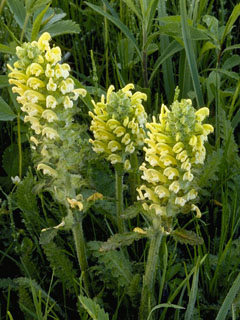
Pedicularis canadensis

The wanderer nodded to the farmer and departed.

------------------
1 "Land walker," wanderer, hobo. The English cognate of "Laafer" is "loafer."

2 "Gribbelschwer" is a debilitating injury to the body resulting from a disease.

3 Lewesgraut, commonly known as Lousewort in English. See discussion below.

Several versions of this tale exist, though the overarching theme of health given in exchange for hospitality runs through all of them.

From the Urglaawe perspective, we are looking at a tale of a visit by the god Wudan, who appears in some tales (explicitly or implicitly) as a wanderer seeking and rewarding hospitality and right action. His simple request for food was exceeded by the farmer's friendly engagement. Thus, Wudan's reward for the hospitality was the restoration of health.

The actual herb used is less clear because multiple names are used in the Deitsch various tales:

Widderkumm (Come Again) = Lousewort (Pedicularis canadensis) or Purple Loosestrife (Lythrum salicaria)

Lewesgraut (Life Herb) = Lousewort (Pedicularis canadensis) or Wood Betony (Stachys officinalis)

The names are complicated further by the English name "Wood Betony" being used for multiple plants, including both Stachys officinalis and Pedicularis canadensis, which are only very distant relatives within the Order Lamiales.

All of these herbs have medicinal value, but the most likely candidate in the context of this story seems to be Pedicularis canadensis, or Canadian Lousewort. Because this plant has parasitic qualities in its relations to other plants, it, at one time, had a unsubstantiated reputation for causing louse infestations in cattle.

Quite to the contrary, Canadian Lousewort has medicinal uses ranging from an aphrodisiac to an anti-tumor to a pot herb to a blood tonic and as a skeletal muscle relaxant... And a bath in a strong decoction can indeed kill lice and scabies.

Thus, we associate the medicinal plants in the Pedicularis family with Wudan as the Herb of Life or Lewesgraut.
Get to know this herb!

Tuesday, April 1, 2014

Til Eileschpiggel and the Dwarves

Til Eileschpiggel had made a nuisance of himself to the Dwarves so much that they decided that he must be dealt with, so they made plans to drown him. 

They made a casket and placed him inside it, and then they started to trek towards the sea. On their way, they came to a tavern, and they went inside to revel in their victory, leaving the casket outside. 

Along came a herder with a large drove of cattle. When Til heard the approaching hoofbeats, he began to call out, "No! I won't do it! I can't do it!"

The herder stopped and listened to the calls, finally answering, "What is it that you cannot and will not do?"

"They want me to marry the king's daughter, and I won't do it. They are taking me to the king to force me to marry her against my will. I won't do it!"

"Let me take your place," said the herdsman greedily, "I'll marry the king's daughter!"

The herdsman took Til's place in the casket and Til took the cattle towards his own home. 

When the Dwarves came out of the tavern, they took the casket to the sea and sank it. They then headed home joyously.

As they neared the gates of their home, the Dwarves were astonished to see Til alive, and even more bewildered to see him driving a huge herd of cattle towards his home. 

Til said, "Down on the bottom of the sea are many such cattle. These I drove from the bottom and up onto the shore, and I brought them home."

All of the Dwarves, eager to get cattle, ran to the sea and jumped in, heading for the bottom. Not one of them resurfaced.