Pages

Showing posts with label Pennsylvania German. Show all posts

Thursday, April 1, 2021

Schadde un Schlumm

Schlumm, whose name means "Slumber," is a brother to Holler. He is a blind and deaf god who walks in the dream states, the meditative states, the altered states, and the subconscious and unconscious mind, etc. He is unable, though, to walk among the wakened, yet it is His greatest desire to do, but not because of His deafness or blindness. He simply wants to move about the realms of existence in the same manner as the other deities.

In Deitsch lore, Sunna and Muun are not siblings; they are star-crossed lovers. They don't start out as star-crossed lovers, though. The conflict in the story arises when the shadowy trickster figure, Schadde ("Shade") develops a toxic obsession with Sunna and wishes to assert his will upon Her to make Her his own. Instead of executing a simple plan and doing the dirty work himself, Schadde, instead wheedles Schlumm into doing some vile work unwittingly (Note: one might think that unwitting states of being would be Schlumm's bailiwick).

SCHADDE UN SCHLUMM

The Schadde, consumed by jealousy toward the courting of Muun, of the Wane, and Sunna, of the Ase, convinces the blind god, Schlumm, of the Wane, that there is a firm veil* that is preventing Him accessing the wakened world. Schadde suggests that Schlumm use his powerful darts† to tear into the fabric of the veil, thereby weakening it enough to allow Schlumm to pass through. 


Schadde advises Schlumm on where to aim his darts, and Schlumm, not realizing that there is no veil, blows them per Schadde's guidance. One strikes Sunna, and another strikes Muun, thus casting a sleep spell over the two.‡ With Sunna and Muun now set to sleep, and the only witness being one who could not observe what just happened in the wakened world.

Schadde takes Muun and Sunna and places them into opposite locations in the skies of Mannheem, so that, when they wake up, they would be unable to consummate their love. When Sunna and Muun do awaken, they are unsure of what happened, and they ask Wudan for an investigation. The investigation yielded a suspicion that Schadde was the cause of the the attack on Sunna and Muun, and the deities call a Ding (Thing) to sort the matter out.

During the Ding, the deities notice that there is an improved stability in Mannheem because Sunna and Muun are now in their skies. Wudan asks of Sunna and Muun a great sacrifice: for the stability of the physical realm, would they be willing to stay where Schadde had put them. The two agreed, although they were sad and frustrated at the impact this arrangement has on their love.

In the Ding's ruling, Ziu sets forth a punishment to Schadde that he can never stand directly in Sunna's presence; something § must always block his view of Her.

Schadde's work is not perfect, though, and, over time, the force of gravity -- and the will of Sunna and Muun -- begin to draw them closer together from time to time, and, every so often, they meet in a solar or lunar eclipse. For the Deitsch, this is a time of revelry and celebration because two deities who made a major sacrifice for the stability of the Hatzholz (Heartwood; the physical universe), are able to share a moment in the embrace that they yearn for all the rest of the days.

_________________

Notes:

This story provides a myth of how shadows came to exist, how the tides came into being, how eclipses came to exist, and possibly even devolution of faculties in the one particular instance of Schadde. This story bears some resemblance to the story of Loki tricking the blind god, Höðr, into shooting an arrow of mistletoe and killing Balder.  

* The actual obstacle for Schlumm to access the waking world varies from version to version, but "veil" ("Schleier") was the most common. 

† Although it does not explicitly say it in this story, other mentions of Schlumm refer to him having several herbs he uses in his darts; mistletoe is the primary.

‡ There are wide variations in whom the darts hit; one, the other, both, or even other deities or beings; however, the remainder of the story does not make sense if it did not hit both Sunna and Muun.

§ A handful of respondents here also used "veil" ("Schleier") in an unusual sense that carried a metaphysical connotation as well as representing any mundane physical object. It lead me to conclude that  Schadde's sentence included a dimming of the mind's eye, so he was somewhat less enlightened. This is a brutal punishment that, ironically, might cast some light on other fragments that relate to Schadde.


Monday, December 31, 2018

Coins on the Windowsill

A common Deitsch tradition tonight is to put a coin (or coins) outside on your windowsill overnight tonight. 

Some variations specify that the coin/s should be silver. Others specify three denominations (nickel, dime, quarter, etc.) of coin. Some Christian interpretations are that these are for the Magi on their way to Bethlehem (PA? lol), while other interpretations definitely have this related to magic that easily fits in with Berchta making the rounds as a beggar. 

If the coin/s are still there in the morning, bring them back in and "Was hawwich yetz wa ich ganzes Yaahr haawe." ("What I have now I will have all year.") 

If the coins are gone, then the need was greater elsewhere, and you will receive good luck for aiding another.

Tonight is Berchta’s feast night, and Urglaawer are preparing for Her requires meal of herring and gruel or Zammede (pancakes made only of flour and water).

Halliches Nei-Yaahr!

Sunday, September 16, 2018

Shaking the World

This week, minor earthquakes with epicenters in Berks County rattled the heart of the Deitscherei, so it is time to revisit some scant references that had grown cold over the years. Although the names were usually unknown to folks with whom I had spoken, more people knew of an "Earthquake Giant" ("Erdbewung-Ries") as a concept.

There are at least three named "earthquake Giants" from different regions: 
  • Der Bollerfuus ("rumble foot") was said to live within the Montour Ridge near Mausdale, PA, in Montour County.
  • In a similar manner, Der Gerumpelfuus (also translating to "rumble foot") was said to live in Raccoon Mountain near Williamsport in Lycoming County, PA.
  • The third, der Zidderfuus ("tremble foot") has no designated home but was actually the name reported around the Lancaster Seismic Zone, which is the region with the most seismic activity in Pennsylvania. 

In the case of their more recent activity, they were said to have been asleep but were re-awakened by human actions, particularly, whether accurately or not, by fracking or by wastewater disposal. In an angry state, they were said "to shake the world around" ("die Welt rumzuschiddle").

Thursday, March 8, 2018

A Tale of der Muunkall (The Man in the Moon)

A man once went hunting in the woods of Yellow Mountain (Berks County) during the last quarter of the moon. When he loaded his gun to shoot at a deer he saw, he hung his powder horn on a horn of the moon, not thinking it odd to be able to do so. 

After he shot the deer, the moon had risen so high that he could not reach his horn anymore. He piled wood to stand on, but the moon kept rising out of his reach until his horn was gone. 

As he came home, he told his neighbors and family about what happened, and they told him that his horn had been stolen by the Man in the Moon and suggested he talk to an elderly woman who lived in the woods. 

The next day, he visited the old woman, who was adept in the magic of Hexerei. She advised him to return to that same spot on the night the new moon. He did so, and he found his powder horn next to the pile of wood he had stood on.

-------------------------

Note: Several variants of this story have emerged from oral reports (numbering a total of 27) in Berks County (where Yellow Mountain was the most common setting) and Lehigh County (where most reports did not give a specific setting and two gave Allemengel as the location). 

In a few reports, the moon was in the last waxing quarter and the horn dropped when the moon was full.

The Man in the Moon was named in most of the reports. In a few others, it was merely the action of the moon rising that caused the hunter not to be able to reach his powder horn. In one report, it was the placement of a horn (powder) onto a horn (moon) that caused the moon to get angry with the hunter and to keep the horn.

In seven of the reports, the hunter was not an honorable man, and the loss of the powder horn could be seen as a punishment.

Monday, January 8, 2018

Gedreier Eckhart: Germanic Psychopomp?

Gedreier Eckhart is one of the more interesting characters in our folklore. For me personally, this is partially because Eckhart is a family surname and also because, somehow, much of my family was aware of the connection between Eckhart and Holle while I somehow did not make the connection until I fully identified as Urglaawer. Weird.

Eckhart [Source: WikiMedia Commons]

There is not a huge volume of oral lore on him from Deitsch lore, but what we do have makes him an important player in the Urglaawe view of the Wild Hunt. Our lore is consistent with much of the lore of other German lands as well.

Eckhart’s roots run deep in Germanic lore. He is of the war band of Dietrich of Bern. He appears as Eckewart the Margrave in the Nibelungenlied, and in a Heldenbuch appendix, he is said to stand before the entrance to Holle’s realm to warn or to frighten away anyone who wished to enter. He also appears in the Middle Ages tale of the Tannhãuser, and Grimm (936) postulates that he was perhaps functioning as a Heathen priest. In our lore, he may have been an incarnation of die Weisskeppich Fraa  (but that sense appears to be an outlier).

Eckhart is a loyal character throughout the heroic legends, but, in Deitsch lore anyway, his title of Gedreier (“Loyal”) comes from his dedication and service to Holle. He appears with a white beard and a white staff. He is deceased, yet he continues to serve the goddess in death just as he did in life. Our lore places him as sleeping in a linden tree or in a rock until Holle has need of him. In Germanic lore, including that of the Deitsch, he precedes the Geischderschtrutz, or the Parade of Spirits (read: the Wild Hunt), warning the living to get out of the way of the impending fury and also advising the living to be prepared for Holle’s inspection.

As the Parade continues and, as Deitsch lore says, meets up with Berchta and the souls of those who have passed since the Hunt began, Eckhart guides the souls of the Parade to Holle’s Mill, where they are crushed into separate parts and reconstituted into new soul constructs. 

In this sense, it appears that Eckhart is very much functioning as a psychopomp, guiding the souls of the deceased to the end of their journey. 

I have been playing the role of Eckhart in Philadelphia’s Parade of Spirits for several years, and I have been reflecting that psychopomp role without giving it due consideration. This year, I intend to make that role more pronounced.

Friday, August 18, 2017

Deitsch Eclipse Lore

Since solar eclipses are so rare, this is getting posted before the research is completed. It will be updated as it progresses.

There are two types of stories related to eclipses. One is sort of "pro" eclipse and the other is rather "con" eclipse. 

An eclipse is called a "Finschderniss" (grammatically feminine, so it takes the article "die"), and an eclipse specifically of the sun is called "Sunnefinschderniss." "Finschderniss" is related to "finschder," means "murky" or "dark." The "pro" story is that Sunna and Muun were lovers (some say married) but that the jealous trickster Schadde had gotten between them (this is where the versions of the stories get confusing, which is why they still have not been published), but he somehow manages to persuade the god associated with sleep, Schlumm, to cast sleep spells on each of them. While they are asleep, Schadde sets them into the sky so that he is between them. 

Sunna and Muun do a dance through the skies, trying to be together, and , when a solar eclipse happens, it means they have achieved that goal, with Muun tossing Schadde behind him. An echo of the noise-making appears in this context with some respondents saying that they tap drinking glasses at this time, which is reminiscent of what people do at weddings when they want the bride and groom to kiss. The reason this is only "sort of" pro is that the way Schadde persuades Schlumm to set them to sleep has something to do with imbalance in Mannheem, and Sunna and Muun being together too long would have catastrophic results. Someday I will get that story's versions harmonized.

The other stories are akin to the Norse and other cultural stories: an animal (usually a fox or a wolf) is chasing the sun and catching it, and banging of pots and pans is performed to scare the animal away.

The first story reminds me a bit of this song...


Lady Sunshine und Mister Moon
können gar nichts dagegen tun,
daß sie am Himmel sich niemals trafen,
denn wenn er aufsteht, dann geht sie schlafen.

Lady Sunshine und Mister Moon
können gar nichts dagegen tun,
wenn sie auch träumen von einem Märchen,
ein Pärchen werden sie nie.

Da sind wir beide besser dran, viel besser dran,
weil mich dein Mund so oft ich will am Tage küssen kann.
Hier unten ist das Leben schön für dich und mich,
dein Mund sagt mir so oft ich will: 'Mein Schatz, ich liebe dich!'

Doch Lady, Lady Sunshine und Mister Moon
können gar nichts dagegen tun,
wenn sie auch träumen von einem Märchen,
ein Pärchen werden sie nie.

Lady Sunshine und Mister Moon
würden gern was dagegen tun,
dass sie so einsam dort oben wandern,
dass sie noch träumen, verliebt vom Andern.

Lady Sunshine und Mister Moon
können gar nichts dagegen tun,
wenn sie auch träumen von einem Märchen,
ein Pärchen werden sie nie. Nie! Nie!

Saturday, April 1, 2017

Synchronicity...

Today I was driving up to the Urglaawe cemetery on back roads. It was a nice day to drive after several days of heavy rain. I noticed that the Hollenbach (the Deitsch name for Jordan Creek in Lehigh County, PA) was flowing particularly strongly (and it normally is pretty fast to begin with), so I pulled onto a side road, got out of my truck, and walked onto a bridge that looks over the creek.

While I was standing there, an old man walked up from the side road carrying fishing gear. He greeted me, and we struck up a conversation. Through the course of the chat, I mentioned the Urglaawe Folklore Research Project, which interested him immensely. This part of Lehigh County is Blobarrick (Blue Mountain) country and is thus Ewicher Yeeger's stomping grounds.

I asked him if he knew any folk stories from the region, and he replied that he did. When I mentioned Ewicher Yeeger, his face lit up, and he said that he knew a few stories. One that he told was very similar to the Ewicher Yeeger story of Allemaengel, but then he told me an anecdote that I found interesting.

He said that when he was a boy, his brother, some friends, and he used to fish in the Hollenbach, and there was an old man, whose name he could not recollect, who used to fish in the creek as well. He said the old man was very mysterious and he was not sure of much about him other than that he was from Werleseck (Werleys Corner) and that people considered him to be a hermit. The old man would talk to the boys and would tell them stories about the area (some of which he related to me).

He said that what he recalled vividly was that he thought some of the man's actions were peculiar. He would throw beans, corn, worms, flowers or plants, cheese, or other items into the creek before and/or after he fished, whether he caught something or not. He said that when the old man would catch a fish, he would utter a word of thanks to the Eternal Hunter for giving him a meal that night. He would then throw some food into the creek for the fish.

When I remarked on only having heard of Ewicher Yeeger in the context of the hunt, he replied, "Fishing is a bit like hunting, gell?"

He then remarked that he thinks of the mysterious old man occasionally when he is fishing or when he walks past the area where the old man used to fish. We continued to to talk as we walked along the creek so he could show me where the man used to fish, and he admitted that he on occasion whispers a thanks to Ewicher Yeeger when he catches a fish or has a successful hunt.

The description given to me about the mysterious man was that he was a Braucher or a Hex and that the man relating this story to me was witnessing the hermit's rituals. The man with whom I was speaking was born "during the time that the people were depressed" so he is likely at least in his 80s, and he said the hermit was very old when he was about age 11-15 or 16. This would put the hermit as being born sometime, perhaps during the 1850s-1870s.

The man said he would ask his brother if he remembered any other stories that the old man or anyone else told when they were boys and he'd contact me if he learned anything.


Friday, March 3, 2017

Der Luul

'Siss Midwinder. Viele vun de Blanzegeischder sinn uff der Wilde Yacht mit der Holle gange. 'Em Reifkeenich sei Griegsmenner sinn iwwer 'm Land am Haerrsche. 

Wie waer's doch mit de annere Blanzegeischder? Sie sinn immer am Schiddle im reifiche Bodde. Wann en Eisgrieger die sehnt wett, er deet die in die Unnergegend schicke.

Wie duhne die driwwerkumme?

Der grie Harr Luul hiedt die.  Sei Ochdem erbaeht die. Sei Hand beschitzt die. Die yingere Geischder  buhle um sei Gunscht vun Ihm. Er iss die Waerming im Kalt. Er iss em Daagslicht sei Suh. Er iss der Lenzing im Winder.

----------------- 

It is midwinter. Many of the plant spirits are on the Wild Hunt with Holle. The warriors of King Frost rule over the land. 

What of the other plant spirits? They are always shivering in the frosty soil. If an ice warrior would see them, he would send them to the Unnergegend. 

How do they survive?

The green Lord Luul watches over them. His breath warms them. His hand protects them. The younger spirits court his favor. He is the warmth in the cold. He is the son of the dawn's light. He is the spring in winter.

----------------- 

One of the more mysterious beings in the Hexerei lore related from Central Pennsylvania by a small handful of respondents, the Luul is the defender of the winter greens and the early spring greens. 

The respondents related to Him as a helpful entity, which is not uncommon among many practitioners of Deitsch folk healing and magic even with known deities such as Wudan, Dunner, and Holle. The text above is an amalgamation of several respondents' statements, but among the more curious comments was from a Sadie M. (not her real name) of Juniata County, who made the specific reference to Luul being the son of dawn's light and the "Lenzing" in winter.

Lenzing can mean "springtime," but it is also an alternate name for the month of March (and is of the same root as "Lent" and is of Germanic origin). March is also the time of the Spring Equinox, or the Oschdre, which is associated in other tales with a goddess of the dawn who brought color to the world. Could Luul be the son of this goddess? 

During discussions on this topic among the Urglaawe community, we learned of the Frankish god known by varying names, including Lollus, Lullus, and Loll. We have looked into a possible link between Luul and Lollus. Lollus is depicted as holding His tongue, presumably because He is youthful (maybe even “Baby New Year” youthful?). Indeed, His name is linguisticlally related to “lollipop” and “lullabye,” so the tongue and the mouth appear to be important features.


Some scholars link Luul to Frey in terms of fertility. Grapes and earns of grain were given to Lollus, and He wore a wreath of poppy flowers around His neck. 


Image Source:
https://www.schweinfurtfuehrer.de/sagen-und-geschichten/schweinfurter-sagen/die-sage-vom-lollus/
Could an echo of the awareness of Lollus have been carried through into Deitsch lore in the form of Luul? Such a link cannot be proven, unfortunately. Nevertheless, Urglaawer honor Luul at New Year's Day, but it would be just as appropriate to honor Him during the month of Lenzing at the time when the weather is particularly capricious. 

While native plants are acclimated to the fickle weather of late winter and early spring, many naturalized plants, particularly annuals, are at risk of germinating during extended warm spells and then being damaged by a cold snap. 

If one accepts the connection between Luul and Lollus as likely, then grapes, grains, and poppies are appropriate offerings.

Some of the greens that Luul may be protecting include the following:

Among the greens that I'd place into this category, at least in this general area, would be Dead Nettles (Daabnessel, Lamium purpureum), Ground Ivy (Grundelrewe, Glechoma hederacea), Chickweed (Hinkeldarrem, Stellaria media), Cuckooflower (Schtruwwlichi Nans in Deitsch; in English, also called Pennsylvania Bittercress or Lady's Smock; Cardamine pensylvanica and related species). There are, of course, others.

There are medicinal uses for all of these, but among the more esoteric uses are the following:

Purple Deadnettle: A strong stand of Purple Deadnettle appearing in the Fall is said to divine a mild winter. Also, if someone is very ill, then the urine of that person is to be collected at night and poured onto Purple Deadnettles. If the Deadnettles were yellow or dying the next morning, then the ailing person should be expected to die from the current ailment. If the Purple Deadnettles were still green, then the person would be expected to overcome the ailment.

Ground Ivy: Sewn into the seams of skirts, this plant is said to increase the likelihood of pregnancy. Also, wreaths of Ground Ivy worn by elderly women around the waist while dancing on Walpurgisnacht/Wonnenacht are said to ward off old age. Similar stories apply to elderly men and women wearing wreaths on the head while dancing around the Midsummer fire. Also, this is one of the Nine Sacred Herbs of Braucherei.

Chickweed: Said via various methods to divine one's love or to attract love. I am not familiar with most of the methods, but one is similar to picking the leaves off of daisies. If you know chickweed, I am sure you can imagine the challenge presented in picking the petals off of the flowers. Perhaps more "Old World," though, is an odd practice that involves feeding a food chicken chickweed three days before it is to be cleaned and dressed, and then divining things from the entrails. The Deitsch name for the plant, Hinkeldarrem, does indeed mean "chicken guts," but most folks ascribe that to the often messy appearance of the plant.

Cuckooflower: Said to be sacred to any number of faeries and land spirits, likely because of the plant's quick, widespread appearance and the volume of seeds.

All of these can also be used alone or in combination with other herbs to detect witches, remove/block curses, and a couple of them can be used in actually casting curses.

Our understanding of Luul will continue to evolve over time.

----------------- 


GardenStone. Gods of the Germanic Peoples 2, pp. 345-347.

Hasenfratz, Hans-Peter and Michael Moynihan. Barbarian Rites: The Spiritual World of the Vikings and the Germanic Tribes, pp. 113-114.

Mein Schweinfurt. Die Sage vom Lollus.

Sunday, May 8, 2016

Wonnenacht and the Wonnezeit

This myth is a product of the Folklore Research Project and represents tales and fragments of tales related principally by folks who identified themselves as practitioners of Hexerei and Braucherei. Some segments of the story were also known to individuals outside of the practices. The term Wonnenacht ("Night of Joy") has been seldom used historically, but it has become the principal term for Walpurgisnacht in Urglaawe. The term Wonnedanz ("Dance of Joy") was related by a Hex from Montour County, PA, and is a replacement for Hexedanz (Witches' Dance), and Wonnezeit ("Time of Joy") describes the twelve-day observance.

Wonnenacht represents the transition from the Dunkelheft (Dark Half of the Year) to the Brechtheft (Bright Half), and the observance welcomes Holle upon Her return from the Wild Hunt.

WONNENACHT AND THE WONNEDANZ


As Sunna's kiss brought increasing warmth and light to the Hatzholz (Heartwood; the physical realm), Holle sent for her ever-loyal servant, Gedreier Eckhart, whose job it was to walk ahead of the Parade of Spirits to warn the living of the fury behind him. Eckhart's love for Holle is as great in death as it was in life, so he flew into the midst of the Host, finding the goddess dressed in white and seated in a wagon being pulled by the souls of nine bulls. The wagon rolled on three great spinning wheels. From each wheel spun a multicolored thread that wove with the the thread from the others, forming a sack of infinite size named Immerraum ("always-room"). The thunderous voices of many found spirits within the sack resounded across the realms.

"I have filled the sack that cannot be filled, and it is time to bring them home," Holle said. "Go forth to Mannheem (the home of humanity within the Hatzholz) and tell the living that they may welcome the Host and that they should be prepared for the visit. Those who remembered and honored my word will be rewarded. After the visit, they are to light two fires and to pass between them. Through that action, they will be renewed. Then you are to go to the Mannheem field, where you will find a lone linden tree under which you may rest until I arrive.”

As Eckhart began his journey into the Hatzholz, announcing the return of the Great Lady, Holle took her mighty Sichel (Sickle) and cut the three threads each, using the end of the strands to tie the sack shut.

The Host crossed from the Oschtbledder (Eastern Leaves) into the Hatzholz. Throngs of people, though scared at first, came out to welcome the parade, honoring the arrival of the wondrous Lady. The clamor of spirits filled the high skies as Holle entered Mannheem. The bulls pulled Her wagon through open windows and doors, seeking those who welcomed Her. The orderly homes served as a sign that Her command was obeyed. She filled the homes with bright light that brought such joy to the residents that they broke out in song and dance.

Presently the wagon approached the Mannheem field called Hexefeld, where Holle found Eckhart sleeping within the bark of a linden tree. She sent the southwest wind, Riffel,1 to awaken him. She instructed Eckhart to lead the Host to Hexefeld and, upon arrival, to cut loose the spirits in the sack. "It is time to meet my sister," she stated.

Eckhart did as he was told. As the Host of the cosmic spirits approached the field, Eckhart saw another parade descending from the clouds, emerging from the forests, and coming from the soil. Ahead of this parade was a brilliant gray light radiating from a beautiful elderly woman who was also dressed in white. Eckhart approached the woman, recognizing Her as Berchta, and he bowed before Her. He then took the lead through the countryside as the two parades merged together and drew closer to the linden tree where Holle awaited them.

A hush fell upon the Host as the two sisters greeted one another. They embraced, and they began to spin in a dance. The dance spun gentle whirlwinds that touched the Host, bringing warmth and joy to the spirits of the Host, and they, too, began to dance. Some gathered strands and dust from the sack, streaming the strands around trees and scattering the dust on the ground.

The Sisters continued to dance with the Host dancing behind them, moving from the field and over the rivers and lakes. Every being in the water began to dance for joy. The whirlwinds spawned gentle rains that awakened the spirits in the sleeping plants, and they, too, began to dance for joy.

The Dance moved to the foothills, where the Frost Giants had taken refuge from Sunna's breath. As the Host approached, the winter vanished, forcing the Frost Giants to retreat.

On the twelfth day, Holle instructed Eckhart to sleep in a rock at the base of a mountain pillar while the dance continued up a ridge called Hexenkopf. The entourage eventually stopped by a marshy wellspring near the top. The two sisters took rest by the wellspring, and the spirits began to feel drawn to its depths.2

Holle and Berchta commanded the Host to continue their journey to its end by Holle's home.

Holle led one half of the parade to an elder bush, the roots of which reached beyond the Hatzholz and into the dark realms, taking nourishment from three creeks named Schprudlendi, Gwellendi, and Fliessendi.3 Berchta led the other half to the depths of the wellspring, which emptied into the same creeks.

THE MILL

The spirits followed the goddesses into these creeks and surfaced in the Holle's meadow, named Bollwies (Flax Meadow), in the Dunkelgegend.4 The spirits followed the goddesses through some woods, passing Holle's home, Es Heisli. They soon entered an open field called Weiwerfeld and soon approached Her Mill.

Holle unhitched the bulls from Her wagon and yoked them to a giant millstone named Seelbrecher ("Soul Crusher"). Behind Berchta, the spirits lined up and entered the Mill, where they would be split apart, never to return in their present form. Holle returned to the joyous Mannheem, taking Her seat upon the Hexenkopf pillar while Eckhart sleeps in a rock.5

BERCHTA LEADS FORTHCOMING SOULS TO UNNERGEGEND

On the other end of the mill, the kernel of the selves of each soul emerged behind Berchta, who then led them up the world tree to the Unnergegend. There they take full form and await their return to the living realms.6

Thus, the Bright Half of the Year began and order was restored to Mannheem. King Frost, fearful of losing his grip on the valuable realm, sent his armies to attack.7

1 In this story, the wind is coming from the southwest; in another myth, the wind directions are known by their destination rather than their origin. Thus, it is possible that the southwest wind in this myth is known by the name of the northeast wind in the other myth.

2 Magnetite was/is common at Hexenkopf and was eventually mined. The most familiar ponds at Hexenkopf currently are ore holes resulting from the mines, but there are also marshy water holes naturally on the mountain that may serve as the reference to the wellspring.

3 The names of the wells translate to Brimming, Bubbling, and Flowing.

4 The Dark Realm

5 There are reports of a White Lady approaching walkers, carriages, and cars along the top of the pillar, particularly around Walpurgisnacht.

6 There is more to this segment to appear in the next version.

7 This is a connection to the Butzemann traditions and the myth of Dunner and the three Frost Giants, Dreizehdax, Vatzehvedder, and Fuffzehfux. At least two versions story have been described frequently under separate cover but will be harmonized either in the next version of this myth or in a separate myth.

Tuesday, March 10, 2015

Oschdre (Where Color Comes From; Origin of the Distelfink)

-------------- PREFACE --------------

Rob had only heard parts of this when he was younger, mostly from relatives or friends of relatives from the stretch between Ashfield and Bowmanstown (version A), PA but also from the Berwick area (version B).  In 2012, Rob asked around the two areas and got leads on some people who may know about the story, and he ended up with 10 new informants for a total of 17. Other informants were familiar with one or two points of the story but not enough to make a significant contribution. More than half of the informants came from farther south, in a stretch from Orwigsburg to New Ringgold (version C). Their versions of the story bore more information and some distinct contrasts with those of the two northern areas. Thus, this particular myth has undergone some reconstruction using as a base the information that the informants provided. The more important variations are noted with footnotes below.

It should also be mentioned that only four informants (all of whom self-identified as knowing Braucherei or Hexerei), looked at any aspect of this as being anything beyond a metaphor. Informant #11 specifically referred to the three Ladies as "goddesses"; #8 referred to Oschdra as a "helpful entity";  #13 and #15 referred to the sisters as "helpful spirits." Therefore, it cannot be said that this was a widespread myth with religious significance historically, but it is applicable to the modern perspectives of Urglaawe.

It is also by no means certain that this is of any particular antiquity; it may be a story that arose in the foothills since the settlement. Thus, it is prudent to encourage readers to look at this as a new myth or a reconstruction or a retelling of a regional folk tale while allowing individuals or kindreds to view it as they will.

Michelle A. Jones and Robert L. Schreiwer

-------------- DIE OSCHDRE --------------

Three sisters, Helling, Nacht, and Oschdra,1 gathered together at a point on the world they called East,2 Each sister wore a cloak of transformative power. Helling wore a cloak of light; Nacht, a cloak of darkness; and Oschdra wore a cloak that could not been seen. They decided to meet at this moment because they were bored with the blandness of existence and wished to make it all appear more interesting and exciting.

Nacht stepped forward first and as She did so, Her cloak covered the world and everything beneath Her and it became black. Oschdra, seeing what happened when Her sister progressed, moved forward next. Only this time, Oschdra’s cloak seemingly had no effect on the world below. Next Helling walked forward, and as She did, the world below Her and Her cloak was cast in white. Most amazingly, as Helling’s white touched Nacht’s black under where Oschdra stood, Oschdra's cloak and everything below Her transformed and could now been seen in a new shade She called "gray."

Oschdra then called upon a pair of Finches,3 Distelfresser and Himmelflucht,4 to fly from Her right hand, a place She called North, to Her left hand, a place She called South. As they would make their flight, everything in their path would be washed in gray.

Distelfresser and Himmelflucht agreed, but asked Oschdra to grant them a simple request: Himmelflucht’s eggs shall also be gray so that she could see them regardless of Helling or Nacht being above them. Oschdra happily granted their request, and the Finches began their flight.

The three Sisters continued their walk around the world. Nacht providing the black hue, Helling, the white, and Oschdra, gray. After nine days, Oschdra became restless once again. She was unhappy that she could only create a tint on the world by standing between Her sisters. She wanted to provide Her very own hue. She looked upon Her cloak and closed Her eyes. She imagined one side of the cloak afire with a varied warm glow and She called it red, orange, and yellow. She imagined the other side luminescent with a cool iridescence and She called it green, blue, and violet.

Oschdra opened Her eyes, and now Her cloak bore all these hues which she called “Farewe,” but in Her own tongue.5 Now as Oschdra walked from the East to the West,6 the skies radiated with the new colors. Her sisters saw the change, and they admired Oschdra’s craft.

Together the three Sisters of the East, thenceforth known as the Oschdre, decided to do more. Helling added white to the colors and Nacht added black. Oschdra’s palette grew and the Sisters loved their work.7 The colors appeared in the sky but not elsewhere in the world. Oschdra and Her Sisters wished for the whole world to emerge with the colors of their work so they sought the assistance of the most prolific of the animal world to help them with their work. They found Haas8 and asked him to transform the world wherever his tail went by saturating everything in its path with the colors of the Ladies' craft. Haas agreed but asked in return that all of his descendents would inherit his role as the bearer of color.

The Oschdre Sisters agreed. While Helling and Nacht stood opposite one another, Oschdra sent Haas forth. Haas was directed to begin at the nest of the Finches, who, having completed their journey, were now flying South to North. Oschdra declared to Himmelflucht, “With Haas' colors, your eggs will always be in your sight.”

Just as Hare painted the last of the eggs,9 Distelfresser landed in the nest to check on them and he was pleased. Haas' tail brushed against him as Haas was leaving and Distelfresser’s plumage transformed to vibrant yellow, blue, green, and red.10

Haas continued on his way, and to this day, wherever Haas goes, color follows his tail.11

-------------- NOTES --------------

1 Only two informants (#13 and #15, both of the New Ringgold area; version C) had names for all three of the ladies: Helling ("Daylight"), Nacht ("Night"), Oschdra ("of the East"). The northern versions (A, B) only listed one individual, the Lady of the East, Oschdra, rather than three. Others in the southern stretch (C) knew one name or another or simply referred to them as "Schweschdere" (sisters).

2 Informant #10 referred to the Lady's home as "Mariyeland" (sometimes spelled "Maryeland"), which could be influenced by the Deitsch name for Morgenland (Lehigh County) and literally means "Tomorrow Land," referring to the East.

3 There is a distinct difference in versions here. Version A refers to a goose while version C refers to a pair of finches. Version B makes no mention of this at all. Rob initially went with the goose route because that was the version he was most acquainted with. However, the goldfinch has as many informants and all of the informants from the area of version C indicated some knowledge (albeit in some cases passive) of the finches being part of the story.

4 Informant #13 (version C) was the sole provider of the names of the finches, and she had stammered significantly on the male's name as she tried to remember what her father had related to her. She ultimately provided Distelfresser ("Thistle-Eater") and Himmelflucht ("Heaven-Flight") as the name of the female. As these were the only names provided, we used them.

5 Whatever word a goddess would use in the language of the Hohegegend (the realm of deity) that would be the equivalent of Farewe ("colors").

6 Almost every informant in versions A and C reported this "walk" from the East to the West. Version B was more simple in a reference to the dawn bringing the colors.

7 Version A included mixing them together to form the earth color brown.

8 Haas ("Hare"). It should be noted that the purpose of the story as related in version B by informant #7 was to explain where the Easter Bunny came from, and the colors were more a secondary tale. In version C, it was the opposite; the purpose of the story was to explain where colors, including those of the Distelfink, came from. Version A fell somewhere in between with more focus on the origination of the colors of the world.

9 This is where the difficulty with version C comes in as the most typical reflections of eggs at Oschdre/Easter are goose eggs and chicken eggs. The only relatively widespread association with smaller bird eggs are those of Robins, who are announcers of springtime in Deitsch lore. The variety of colors and shades among house finch eggs, though, is not to be dismissed. And, also, sometimes a metaphor is just a metaphor.

10 There was some disagreement among the version C informants of this segment. Two informants stated yellow and called it Distelfink.. two stated yellow and red and called it Distelfink... and three related yellow, blue, green, red and called it by both Distelfink and Bird of Paradise. It is anyone's guess whether any of these was the original version or any/all were an alteration to the story to reflect the artistic concepts of the Distelfink/Bird of Paradise depictions. The one conclusion we do draw from this particular tale, though, is that Distelfink got its colors from Haas on his mission to paint the world. Stressing again: It is also by no means certain that this is of any particular antiquity; it may be a story that arose in the foothills since the settlement.

11 This is probably the most widespread portion that people in general remember, even if vaguely, outside of the informants on the list.

Thursday, February 19, 2015

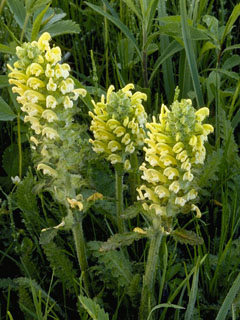
Lewesgraut - Herb of Life

One day a Landlaafer1 arrived at a farmhouse seeking food. The farmer, who was crippled by an old injury2 from a disease, invited the wanderer in and offered him food and drink. The farmer sat with the wanderer, and the two talked as if they were old friends.

When the wanderer finished his meal, he said, "You have been kind to me. In return for your hospitality, I will bring you a plant that will bring you strength." He left the farmhouse and returned later holding the plant.

"This is the Herb of Life.3  Use it to restore your health."
Pedicularis canadensis

The wanderer nodded to the farmer and departed.

------------------
1 "Land walker," wanderer, hobo. The English cognate of "Laafer" is "loafer."

2 "Gribbelschwer" is a debilitating injury to the body resulting from a disease.

3 Lewesgraut, commonly known as Lousewort in English. See discussion below.

Several versions of this tale exist, though the overarching theme of health given in exchange for hospitality runs through all of them.

From the Urglaawe perspective, we are looking at a tale of a visit by the god Wudan, who appears in some tales (explicitly or implicitly) as a wanderer seeking and rewarding hospitality and right action. His simple request for food was exceeded by the farmer's friendly engagement. Thus, Wudan's reward for the hospitality was the restoration of health.

The actual herb used is less clear because multiple names are used in the Deitsch various tales:

Widderkumm (Come Again) = Lousewort (Pedicularis canadensis) or Purple Loosestrife (Lythrum salicaria)

Lewesgraut (Life Herb) = Lousewort (Pedicularis canadensis) or Wood Betony (Stachys officinalis)

The names are complicated further by the English name "Wood Betony" being used for multiple plants, including both Stachys officinalis and Pedicularis canadensis, which are only very distant relatives within the Order Lamiales.

All of these herbs have medicinal value, but the most likely candidate in the context of this story seems to be Pedicularis canadensis, or Canadian Lousewort. Because this plant has parasitic qualities in its relations to other plants, it, at one time, had a unsubstantiated reputation for causing louse infestations in cattle.

Quite to the contrary, Canadian Lousewort has medicinal uses ranging from an aphrodisiac to an anti-tumor to a pot herb to a blood tonic and as a skeletal muscle relaxant... And a bath in a strong decoction can indeed kill lice and scabies.

Thus, we associate the medicinal plants in the Pedicularis family with Wudan as the Herb of Life or Lewesgraut.
Get to know this herb!

Tuesday, April 1, 2014

Til Eileschpiggel and the Dwarves

Til Eileschpiggel had made a nuisance of himself to the Dwarves so much that they decided that he must be dealt with, so they made plans to drown him. 

They made a casket and placed him inside it, and then they started to trek towards the sea. On their way, they came to a tavern, and they went inside to revel in their victory, leaving the casket outside. 

Along came a herder with a large drove of cattle. When Til heard the approaching hoofbeats, he began to call out, "No! I won't do it! I can't do it!"

The herder stopped and listened to the calls, finally answering, "What is it that you cannot and will not do?"

"They want me to marry the king's daughter, and I won't do it. They are taking me to the king to force me to marry her against my will. I won't do it!"

"Let me take your place," said the herdsman greedily, "I'll marry the king's daughter!"

The herdsman took Til's place in the casket and Til took the cattle towards his own home. 

When the Dwarves came out of the tavern, they took the casket to the sea and sank it. They then headed home joyously.

As they neared the gates of their home, the Dwarves were astonished to see Til alive, and even more bewildered to see him driving a huge herd of cattle towards his home. 

Til said, "Down on the bottom of the sea are many such cattle. These I drove from the bottom and up onto the shore, and I brought them home."

All of the Dwarves, eager to get cattle, ran to the sea and jumped in, heading for the bottom. Not one of them resurfaced.

Tuesday, October 29, 2013

The Legend of Delbel the Butzemann

A retelling of a Deitsch folk tale
by Robert L. Schreiwer

Harr Meyer was a pleasant man and a diligent farmer. Unfortunately, he had experienced a farm injury as a young man, and, now as an old man, he walked with a pronounced limp on his right leg. With each passing year, Harr Meyer encountered more and more trouble keeping up with his crops and felt less and less confident in his ability to care for them.

One year, as the snows of winter roared, Harr Meyer finally decided he needed help with the protection of his crops. His bones were aching, and his old injury was throbbing from the icy humidity. In order to seek some relief from his pains, Harr Meyer visited his village Braucherin1, who was renowned for her herbal wisdom, healing touch, and keen insights.

The Braucherin greeted Harr Meyer as usual, and, throughout the course of their conversation, Harr Meyer asked for the Braucherin's advice regarding his plight with his crops. The Braucherin immediately replied that Harr Meyer should construct a Lumbemann2 from crop remnants in the fields and bring him to her for activation on Grundsaudaag3. 

Harr Meyer did not understand what activation was, but, upon leaving the Braucherin's cottage, he did as she had instructed and built his scarecrow. Thinking that he and the scarecrow together made a whole unit, he constructed the scarecrow with weaker materials in his left leg. "His left limp will match mine," thought Harr Meyer.

On February 2, he returned to the Braucherin, bringing his scarecrow with him. The Braucherin took the  Lumbemann and whispered some incantations over his head. When the Braucherin asked Harr Meyer what he'd like to name this scarecrow, he thought of the limp, and answered, "Delbel4." She continued her incantations, this time also drawing symbols over the scarecrows head. She then took a deep breath and exhaled it over the mouth of the scarecrow.

"Daer do iss dei Butzemann, Delbel der Nei5," she announced, holding the newly activated scarecrow up to a bewildered Harr Meyer. She then provided Harr Meyer with additional instructions for his scarecrow, stating that, if he followed them carefully, this "Butzemann"6 would patrol his land and help to protect his crops.

"Most important, though," said she, "is that you set him afire no later than Allelieweziel7, when Holle8 calls for him. Otherwise, trouble will beset everyone and everything around you." Harr Meyer shrugged and returned home.

Harr Meyer observed the Braucherin's instructions faithfully throughout the spring. He showed Delbel his turf, provided him with clothes and a perch, and he lavished offerings of molasses and milk upon the Butzemann. In turn, Delbel grew stronger. The plant spirit within him grew bolder. At night, Delbel would emerge as a spirt from the scarecrow shell. Despite his limp, he learned to fight the Frost Giants and to keep troublesome land spirits at bay.

By Midsummer9, Harr Meyer's land was bursting with bounty. Delbel was very happy on his perch by day and in the fields by night. Harr Meyer continued to reap the richness of the land and to share his wealth with Delbel throughout the Hoiet10.

One day, Delbel noticed that Harr Meyer was not out working in the fields. He continued his own work in the fields, scaring away birds and dangerous spirits alike. Two more days passed, and Harr Meyer had not returned to the fields.

Delbel became concerned when he noticed a large group of people, dressed mostly in black, carrying a large wooden box down the lane from the house. As the group came closer, Delbel could see his master, stretched out inside of the box. Although Delbel was not highly experienced with the world of humans, he knew that what he was seeing was not pleasant.

Delbel resumed his work. Week after week passed, and the crops became overgrown and began to wither. Then the day temperatures turned cooler, and the Frost Giants began to attack at night. Delbel watched the leaves on the trees change color. When he noticed that the crops were beginning to fade, Delbel also began to feel an unexplained pull towards the ground. 

This sensation grew stronger with each passing day, and the source of this pull felt closer and closer to the surface of the ground beneath him. He felt more and more drawn to it. He wanted to be with it, even though he was unsure what it was. 

One day, Delbel noticed an odd little man loafing around the edge of his turf. His back appeared to be buckled and crooked, and Delbel felt very uneasy about his presence. At night, the little man suddenly shifted in his shape. He maintained his crooked back, but Delbel now sensed that this was a dangerous spirit.

Each day, Buckliches Mannli11, as Delbel called him would approach the edge of Delbel's turf, but he would not cross the line. He did not seem interested in the crops, though; instead, he seemed most interested in observing Delbel's actions.

And, each day, the pull became stronger, until the source was almost within Delbel's reach. He felt a dazzling energy coming from the land below him. Delbel now realized that it was time for him to leave his turf. Delbel yearned to be with the source of this energy, but he was disturbed by Buckliches Mannli's persistent interest.

Finally, one crisp autumn night, Delbel felt the energy arise from beneath him. A beautiful White Lady emerged from the ground, enveloping him and pulling his spirit upward from the shell of the scarecrow.  She arose above him, filling all of the night sky with ethereal light and warmth. Delbel felt himself beginning to depart from his body, and he was elated by the glory of all he was witnessing.

At that moment, however, Delbel felt a tremor in his physical shell. "Buckliches Mannli!" he exclaimed, "He's taking my body!" Delbel fought to keep the strange spirit from overtaking his shell. The scarecrow fell to the ground, breaking the plant stems that made up Delbel's weak left leg. The impact of the fall pushed Delbel's spirit from the shell. Delbel was saddened to have lost his body to Buckliches Mannli, but he was now free to join the White Lady Holle on her journey through the skies.

As Delbel joined a parade of souls behind the goddess, his joy was suddenly interrupted by the realization that part of his soul was missing. Although he was loath to leave the parade, he decided to search for the part of him that was missing.

Upon returning to his turf, he observed his limping shell, which Buckliches Mannli had stolen creating all sorts of mayhem. The fields were aflame. The neighboring cattle had been let loose, and the neighborhood children were quaking with fear. 

Delbel panicked. He had lost his turf, and the whole community was in chaos. He sought help from the neighbors, but, without his shell, no one noticed he was there.

Delbel began to move about the land, following in reverese the path that Harr Meyer had walked when he brought Delbel home from the Braucherin. Delbel eventually came upon the cottage in which he was born. He peered through a window, and he saw the Braucherin sitting and meditating at her altar.

Delbel walked through the walls, and immediately the Braucherin stirred. "Delbel der Nei," she whispered. "What brings you here?"

Delbel had never spoken a word aloud before, so he was not sure that the Braucherin would hear him. "I am in need of help."

The Braucherin replied, "I hear you. Tell me what is amiss."

Delbel narrated the story to the Braucherin, who quickly arose from her seat. She uttered some incantations and drew some symbols over Delbel's soul. She then grabbed a bag, emptied its contents, which were some branches, into a large pot, and set them ablaze.

She returned to her seat and continued her incantations in a whispered voice, and all Delbel could make out were the names of Hasselheck12 and Hollerbeier13. 

The Braucherin stood up. "The leg of your soul calls out to the smoke in the bowl," she said. "Let us take the pot and follow the smoke of the burning branches."

The Braucherin and Delbel hastily trailed the smoke into the dark night. The smoke led them to a neighboring farm's chicken coop, where Delbel saw his limping shell breaking the eggs beneath sitting hens. When Buckliches Mannli saw Delbel, he attempted to run, but his left leg gave out under him.

The Braucherin grabbed the shell, drew symbols upon its head, and uttered some incantations. She then pushed the shell into the pot with the burning branches, setting it on fire. Buckliches Mannli jumped out along with the left leg of Delbel's spirit. Although the two parts were not connected, Delbel was still able to use his left leg to kick Buckliches Mannli down to ground, and the Braucherin banished the troublesome spirit from the physical realm.

Delbel absorbed his leg back into his soul. He was pleased to be intact, but he was saddened that he was no longer in the parade of souls. 

"Fret not," said the Braucherin. "The burning branches can lead you to your destination, too." She blew the smoke from the pot onto Delbel, and Delbel felt the energy once again around him. 

He fell into what seemed like a deep sleep, and, when he awakened, he was in a blooming meadow that surrounded a large mill. Delbel's last words were a request to the goddess for blessings to be bestowed on the Braucherin, who helped him to save the community.

The Braucherin returned to her cottage and went to sleep. She awoke the next morning to the sound of knocking on her door. She opened to door and was handed a message that informed her that she was the heir of the late Harr Meyer's farm. 

Each year since then, the Braucherin has remained in her cottage but tended to Harr Meyer's land. For the remainder of her life, she continued the tradition of building a Butzemann of Delbel's lineage each year. 

------------------
1 Braucherin: A wise woman trained in the Deitsch healing tradition of Braucherei.

2 Lumbemann: A scarecrow.

3 Grundsaudaag: Groundhog Day, February 2

4 Delbel: Awkward person

5 "Daer do iss dei Butzemann, Delbel der Nei": "This here is your activated scarecrow, Delbel the New." The naming of scarecrows follows the old Deitsch convention. For more information on that convention, please see http://urglaawe.blogspot.com/2012/02/butzemann-naming-convention.html. 

6 Butzemann: A spiritually activated scarecrow.

7 Allelieweziel: October 31

8 Holle: Goddess of land fertility who leads the Wild Hunt of souls through the realms starting on Allelieweziel

9 Midsummer: Summer Solstice

10 Hoiet: Haymaking time; month of July on the Urglaawe calendar

11 Buckliches Mannli: Also known as 'S Bucklich Mannli or Butz. Bogeyman. A mischievous and dangerous field- or house-spirit. Akin to a puck or a pucca. 

12 Hasselheck: Hazel bush

13 Hollerbeer: Elder, only parts of which can be burned in matters relating to Holle.

------------------
When citing this article, please use the following information:

Schreiwer, Robert Lusch. The Legend of Delbel the Butzemann. deitschmythology.blogspot.com October 29, 2013. Bristol, PA: Deitscherei.com, 2013.

Sunday, October 6, 2013

Holle's Mill

This post is spurred on by an article in Denali Institute of Northern Traditions' May 2013 issue of True North. The article, The Magical Mill, referred to the presence and role of mills in various European mythologies, including Norse and Finnish.

As is the case with so many European folk religions and traditions, Urglaawe retains lore and knowledge of a major mill from Braucherei oral tradition. “Die Miehl” is by the hall of Holle, and it is in this mill that Holle takes the souls of the departed for processing between lives. 

The mill is said to separate the different pieces of the soul in order to release the returning components. In Urglaawe understanding, the portions of the soul that are released are the Urleeg (Ørlög) and the eternal Hoch (Higher Self; the divine spark). The Glick (Luck/Hamingja) is sometimes also passed from construct to construct. Additionally, the Folyer (Fetch/Fylgia), which, in Urglaawe, is seen as an independent entity that attaches itself to a new soul constructs, is freed to find another symbiotic host. The Urleeg, Glick, and Hoch may remain together or be separated into new soul constructs.  

The purpose for the milling is, in Urglaawe belief, to prepare the Hoch quickly for a continuing upward spiral of advancing consciousness. In the deities’ effort to thwart the forces of chaos (which in Urglaawe feature ignorance, apathy, rootlessness, and unenlightened self-interest along with the physical threats described in the story of Ragnarök), the advancement of human consciousness is one of their biggest investments. 

With each lifetime and variation in the interaction of the soul components, the Hoch is to increase its ability to understand existence and to assert its will into improving the existence. In short, the deities want us to be, at the end of this cosmic cycle, where they were at the beginning of it. It is, therefore, in the deities’ interests to keep the Lewesraad (the cycle of life, death, decay, and rebirth) moving along expeditiously.  

In fact, the Urglaawe view of the Wild Hunt pertains directly to this battle with chaos. In our oral lore, it is Holle who leads the Wild Hunt (though Wudan and She are often together, too). Her purpose is to find any souls that have fallen out of the Lewesraad cycle and to bring them back into it. She is followed through the skies by the souls that She has found or that have sought Her out. It is for this reason that the Deitsch culture associates Allelieweziel (Halloween) with the departure of Holle from this plane.  

In Braucherei, there are intervals in the spiritual year that the veil between the physical and spiritual planes (or among the worlds of the multiverse). Allelieweziel and Grundsaudaag (Groundhog Day), in particular, are times at which many Braucherei practitioners engage in soul work to direct lost or distressed souls towards the Miehl. It is also noteworthy that the same processes and cycles pertain to animal and plant spirit constructs, though they differ from those of humans.  

Holle’s Miehl plays a central, critical role in the purpose of human existence, purpose, and advancement. Many of us believe humanity is currently backsliding due to the dereliction of responsibility for one’s own advancement (another article unto itself), and it up to us to aid our deities’ efforts by striving to live our lives more deliberately, being conscious of the impact of our thoughts, words, and actions.

-----------
Please use the following information when citing this entry:

Schreiwer, Robert Lusch. Holle's mill. deitschmythology.blogspot.com, October 7, 2013. Bristol, PA: Deitscherei.com, 2013.

Sunday, August 18, 2013

The Legendary Hexenwolf


For those who are unfamiliar with the Hexenwolf videos that appeared at the Virginville Film Festival in 2006, they are available on YouTube.

Those who are familiar with these parody videos, however, may not be aware that the Hexenwolf is indeed a character in some little-known Pennsylvania German folktales. Much like the Jersey Devils wreak havoc across the Pine Barrens, the Hexenwelf (plural form) inhabit tracts of land across much of eastern Pennsylvania. Some folks say they are generally invisible, but they can manifest themselves in a visible form at will. Others say that they are not actually invisible, but, like a cuttlefish, are able to blend into their environment in an extremely effective way. Although those who claim to have seen it describe an animal similar to a Jersey Devil, the Hexenwolf has never been said to have wings. 

Dwayyo/Hexenwolf
It is more likely that the Hexenwolf is identical to the Dwayyo, which is a mythic creature mentioned in the Deitsch regions of Maryland. The Dwayyo is said to be the predator of another mythic creature, the Schneller Geischt or the Snallygaster.

They are nocturnal creatures, perhaps baneful wights or spirits, that have little use for humans, particularly humans' streetlights, headlights and flashlights. Thus, the Hexenwelf tend to hunt at night and sleep during the day. However, crossing their path while they are hunting could be deadly... Even if you are not physically harmed, these creatures are said to be able to exert a dark force upon you, which leaves a blemish and plagues you with bad luck.

Many tales of the Lenape did not survive the Colonial era, so we will never know whether these are native creatures or whether they came over with our ancestors, hidden among their possessions.

They have been said to dwell in woods or meadows near Oley, on the ridges by Cushion Peak, Eagle's Peak, The Pinnacle, and in the Welsh Mountains. Some say they inhabit the woods atop Mount Penn at the far end from the Pagoda, and on some nights hunt in packs, on two legs or on four. The wooded areas not far Angelica Lake seem to be a favorite home. In the north, they are said to avoid the Blue Mountain Ridge, perhaps due to the presence there of Der Ewich Yeeger, the Eternal Hunter, but on the other side of the ridge, the stories re-emerge in the wooded areas just north of Mauch Chunk/Jim Thorpe.

Stories indicate that they occasionally let out howls like wolves; other stories say they have the ability to project their thoughts into the minds of those whose gaze they catch, and that is one way they stop their prey.

They have been rumored to have ransacked root cellars and garbage cans. They have also allegedly attacked livestock, chickens, but for some reason they do not attack dogs and cats. In fact, cats have been reported among their numbers on occasion, traveling comfortably with the pack.

So make what you will of these almost-forgotten tales, and if you are hiking along the back roads of Deitscherei, be wary of the night hunters, and keep your flashlight on!

Wednesday, July 3, 2013

How the Deitsch Nation Was Born...

There are the historical facts of the Great Migration of the German settlers from Europe to the British Colonies in America. Then there are the folk tales that relate to the unseen mechanisms behind this Migration.

Every good Deitsch person, regardless of religious identity, should recognize Francis Daniel Pastorius as the foremost leader of the Deitsch nation. There were plenty of others who operated throughout the Colonial and Early Republic eras to bring about the creation of Germantown, PA, and the spread of the Deitsch nation down the Appalachian Mountains and into the Midwest.

Pastorius Monument, Vernon Park, Philadelphia


There's a backdrop story to this Migration, though, and it falls into the misty folk memory of the old Teutonic gods and goddesses. This is not a new story. Although Holle is sometimes conflated with the Gnostic Sophia in different versoins of this tale, Her role in the creation of the Deitsch nation is a longstanding myth in Braucherei and Hexerei.

How the Deitsch Nation Was Born

The gods and goddesses were saddened by the compulsory conversion to Christianity and all of the strife that the folk had suffered as a result of the persecution by the Church and the subsequent religious wars. The deities had sent tribes out from the north to settle distant lands, such as Iceland, and to try to keep the believers isolated. However, the deities guide but do not force humans to make the right decisions, and the ruling classes continued to embrace the power that the Church power structure imbued in them.

Thus, the folk continued to lose its way due to leadership by greed- and power-driven rulers.

The Thirty Years' War served as the breaking point in the deities' patience. They watched as interdenominational war plagued the lands of the Germans, wiping out huge portions of the population of the German states, with Württemburg losing 75% of its population! The economy of Central Europe was destroyed, and the political importance of the Palatinate was thoroughly obliterated. 

The goddess Holle was horrified by the destruction that took place all around Her lands. She recognized that the folk were stuck in a cycle of religious confusion and war, with blame to be laid primarily at the feet of the leadership that cared more about power and control than about the folk's success. She, therefore, subtly guided the most peaceful of the folk, regardless of religious identity,  to lead the Migration.

Holle's hand became a moving force in the Migration through the manipulation of the leadership to bring about an emigration for any reason. The targeted lands were the relatively peaceful colonies of the Americas. The most desired people were the peasants, serfs, and farmers, who remained a step closer to the Old Ways than did the ruling classes. Among these folks would be the healers of Braucherei and the practitioners of Hexerei; these groups would carry the Old Ways with them to the New World. The agricultural folk had no desire to destroy; instead, they looked to nurture an independent life in a peaceful land. 

The deities aided the Migration at every step, even if credit were improperly being attributed to the power structure of another religion. Upon arrival, though, the conflicts of Europe quickly eroded; religious bodies that were at each other's throats in Europe found themselves sharing resources in America. The Deitsch moved into the hinterland of the Colonies, kept peaceful relations with the Lenape, sympathized with the slaves in the South, and used their skills to build the countryside. 

As the peace spread over this land, now called Deitscherei in the regional vernacular, Holle took a seat upon the mountain pillar known as Hexekopp (Hexenkopf), from which She would watch the progression of Her new nation, the Pennsylvania Germans, now called the Deitsch, as they embraced the old deities and recognized the rightful place of humanity on the Tree of Life (Lewesbaam).

This is how Holle came to be the Mother of the Deitsch Nation.